
HOMER Knowledge Base
HOMER and SWERA web services
What start up condition are we trying to achieve?
Currently I have the web service creating a document that can be File->Import XML into the Homer program. Something I kind of had a problem with is that you can't see the data until you say that there is a PV or a wind turbine. Should the Homer XML just include these? Should it also force Homer to say what coordinates we are at based upon the query that was done on the SWERA Web Service?
I have declared some defaults based on what was not in the data and what homer uses as defaults. I wanted to make sure that these were correct assumptions.
autocorrelation_factor = .850
diurnal_pattern_strength = .250
hour_of_peak_windspeed = 15
altitude = 0
anemometer_height = 50
surface_roughness_length = .01
weibull_k_default = 2 (used if not defined by the data layer)
It’s true that HOMER doesn’t display the solar resource data until the user adds a PV panel to the schematic. Similarly, it doesn’t display the wind resource data until the user adds a wind turbine to the schematic. I’m not sure whether that’s an issue for you or not. When we implemented the web service that downloads solar radiation data from the NREL website, we put it in the Solar Resource Inputs window, so to use that service the user adds PV, opens the solar resource window, and requests the data. The same process could work in the Wind Resource Inputs window.
The default values you listed are all okay except for the diurnal pattern strength and the hour of peak wind speed. Years ago I decided on the default values for the weibull k, autocorrelation factor, diurnal pattern strength, and hour of peak wind speed by analyzing the TMY2 data set, all of which was measured at 10m above ground. At that height, the wind tends to peak in the afternoon, most commonly at 3pm, so I set the default hour of peak wind speed to 15. And the diurnal pattern strength (the ratio of the amplitude of the daily pattern to the average) tends to be around 0.25 at that height. But I have since learned that things are very different at 50m.
The following graph shows the mean daily wind speed profile for a location in North Dakota, where the wind speed was measured at three heights up to 56m above ground. This graph shows a very typical profile, where at 10m above the surface, the wind peaks in the afternoon, but at 50m above the surface it does almost the opposite. At 50m, it’s windiest during the night. I haven’t done a comprehensive study, but I have seen lots of wind resource data sets and almost every one of them looks like this:
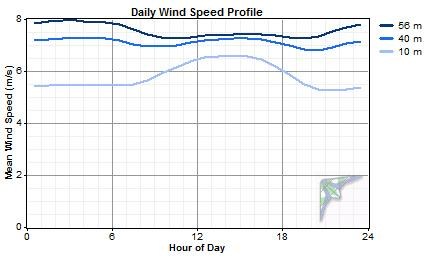
The diurnal pattern strength and hour of peak wind speed parameters are meant to characterize the shape of that mean daily profile graph. HOMER’s default values are fine for an anemometer height of 10m, but if your default anemometer height is going to be 50m, I would default the diurnal pattern strength to a much lower value, like 0.1, and the hour of peak wind speed to 3.