Utility-scale & Cross-cutting — Multi-product
Maximize the return on every MW you develop
HOMER Front models the multi-year dispatch and revenue of utility-scale solar, wind, and battery storage projects—helping developers optimize system sizing, structure offtake agreements, and produce the bankable analysis that secures financing.
Hybrid project economics are complex—and the stakes are measured in hundreds of millions
Utility-scale hybrid projects—solar + BESS, wind + BESS, or multi-technology portfolios—require sophisticated dispatch modeling to accurately forecast revenue streams. Energy arbitrage, capacity payments, ancillary services, and contracted offtake all interact in complex ways. Oversizing storage wastes capital; undersizing leaves revenue on the table. And your lenders won't fund the project without a credible, bankable model. Getting the analysis right isn't optional—it's the difference between a funded project and a stranded pipeline asset.
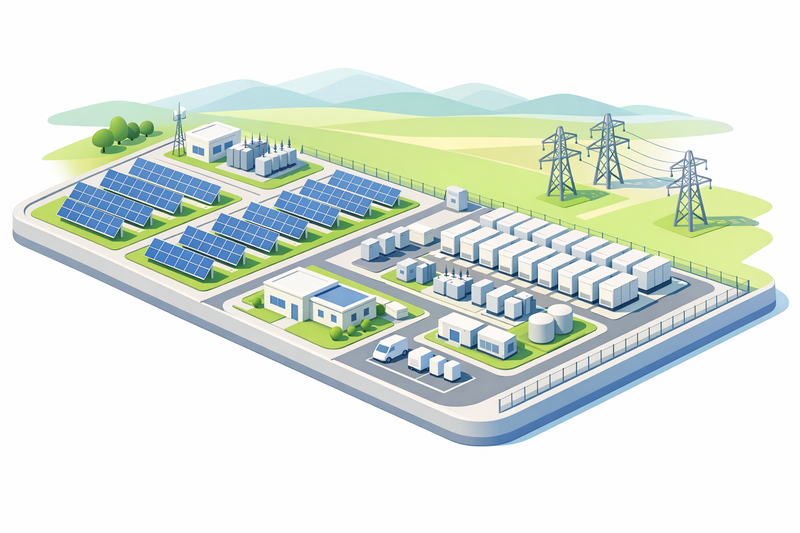
Critical pain points
Why hybrid project economics can stall deals
Revenue Uncertainty
Merchant revenue from energy arbitrage and ancillary services depends on volatile market prices. Without robust multi-year dispatch modeling, revenue projections lack credibility with lenders.
Sizing Trade-offs
Should you pair 200 MW solar with 50 MWh or 400 MWh of storage? The answer depends on market prices, degradation, interconnection limits, and offtake structure. Trial-and-error is too slow and too expensive.
Bankability Requirements
Project finance lenders and tax equity investors demand independent, verifiable techno-economic analysis. Your internal model isn't sufficient—you need a tool with market credibility.
Pipeline Velocity
Competitive development means fast iteration. Months-long analysis cycles for each project configuration delay interconnection filings and offtake negotiations.
Front-of-meter revenue optimization for hybrid projects
HOMER Front is purpose-built for utility-scale hybrid project analysis. It models multi-year dispatch of solar, wind, and BESS against market prices and contracted revenue streams—optimizing system sizing and configuration to maximize project IRR. Built on the trusted HOMER platform used by 250,000+ professionals worldwide, HOMER Front delivers the bankable outputs that developers and their financing partners require.
Core modeling advantages
Built for confident decisions
Multi-Year Dispatch
Simulate year-by-year system operation over the project's 20–30 year life. Account for solar degradation, battery cycling limits, augmentation schedules, and evolving market price forecasts.
Revenue Stream Optimization
Model energy arbitrage, capacity payments, ancillary services (frequency regulation, spinning reserve), and contracted PPA revenue—separately and co-optimized—to find the revenue-maximizing dispatch strategy.
Bankable Analysis
Generate the financial outputs lenders require: IRR, DSCR, LCOE, NPV, cash flow waterfalls, and sensitivity analysis on key variables (market prices, degradation rates, capex).
Additional Capabilities
- + Market participation modeling: Model dispatch against ISO/RTO market structures including day-ahead and real-time energy, capacity, and ancillary service markets.
- + Degradation and augmentation: Model battery degradation curves and plan augmentation schedules (adding cells at year 7, 12, etc.) to maintain contracted capacity over the project life.
- + Sensitivity and risk: Run hundreds of scenarios varying market prices, weather years, degradation assumptions, and capex to quantify project risk and identify bankable base cases.
Use Case: Optimizing a 200 MW Solar + 100 MW/400 MWh BESS Project
The Situation
A renewable energy developer is advancing a 200 MW solar + BESS project in ERCOT (Texas). The site has an interconnection agreement for 250 MW. The developer needs to determine optimal storage sizing, evaluate the revenue mix between a 10-year fixed PPA and merchant exposure, and produce a bankable financial model for their tax equity partner and project finance lender. The project must reach financial close within 6 months.
What Was Modeled
Using HOMER Front, the developer's asset valuation team modeled 25-year dispatch for each storage configuration against ERCOT nodal price forecasts. Revenue streams included contracted PPA (10-year, $35/MWh), merchant energy and ancillary services, and capacity value. Battery dispatch was co-optimized across energy arbitrage, ancillary services, and PPA obligations. Sensitivity analysis tested 3 market price scenarios and 2 solar resource years.
The Outcome
Optimal configuration: 100 MW / 400 MWh storage. Blended project IRR: 12.4% (levered), with the 10-year PPA providing 65% of revenue certainty and merchant exposure adding 3.2 percentage points of IRR upside. The HOMER Front model was reviewed and accepted by the tax equity investor and project finance lender, with financial close achieved on schedule. Total project value: $380M.
Real-World Applications
| Location / Client | Project Type | Key Result |
|---|---|---|
| Hybrid Projects Company | Growing pipeline of solar + BESS projects in Texas using HOMER Front analysis | Revenue optimization in the most dynamic U.S. wholesale market |
| HOMER Front Launch | Purpose-built for utility-scale hybrid project developers and IPPs | Multi-year dispatch, market participation, bankable financial outputs |
| UL Solutions Advisory | Independent engineer services supporting project finance | HOMER + UL advisory provides the credibility package lenders require |
| Industry Trend | Hybrid solar + storage projects surpassing standalone solar in interconnection queues | HOMER Front positioned for the fastest-growing segment of renewable development |
Recommended HOMER Products
HOMER® Front
Utility-scale investment
HOMER Front is the only HOMER product built specifically for front-of-meter, utility-scale hybrid projects. It models multi-year dispatch against wholesale market prices and contracted revenue, producing the bankable analysis that developers and their financing partners require.
Key Modules: Market participation, degradation/augmentation, sensitivity analysis
Supporting Services
Advisory Services
UL Solutions independent engineer services for project finance: bankability assessments, revenue forecasts, and technology due diligence. The credibility package that gets projects funded.
Learn More →Engineer Hours
Hire a HOMER specialist to accelerate your pipeline analysis, build project models, and prepare financial close materials for your lending partners.
Learn More →Regional focus
Utility-scale developer markets and storage auction context by region.
Selected HOMER research
View full bibliography →Studies on grid-connected and utility-scale hybrid generation that used HOMER, drawn from the bibliography of 1,000+ publications.
-
Economic Analysis of Standalone and Grid Connected Hybrid Energy Systems
Turkay, B.E. & Telli, A.Y. (2011). Renewable Energy, vol. 36(7).
-
Techno-Economic-Environmental Assessment of Stand-alone Hybrid Renewable Energy System for Different Batteries using HOMER-Pro
Solanki, A., Singh, P., Pandit, M., Sawle, Y. et al. (2024). International Journal of Mathematical, Engineering and Management Sciences.
-
Optimal energy mix for a grid connected hybrid wind–photovoltaic generation system
Vuc, G., Borlea, I., Barbulescu, C. et al. (2011). IEEE 3rd International Symposium on Exploitation of Renewable Energy Sources.
Ready to optimise your next hybrid project?
HOMER Front gives developers the dispatch modeling and bankable analysis needed to size projects correctly, maximise revenue, and reach financial close on schedule. Request a demo or talk to our utility-scale team.