Off-grid & Remote — HOMER Pro
Reliable, low-cost power for every tower in your network
HOMER Pro helps mobile operators and tower companies design optimal hybrid power systems for cell towers—reducing diesel consumption by 40–70% while ensuring the always-on reliability your network demands.
Powering the world's most distributed infrastructure
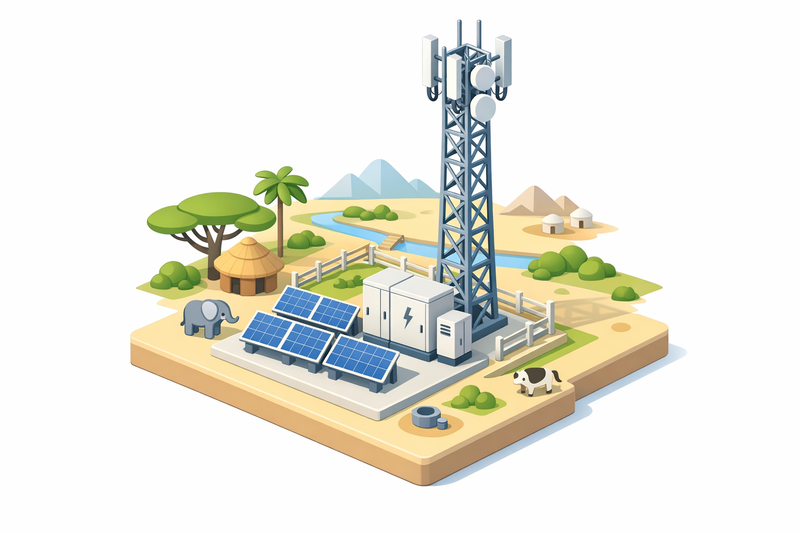
There are over 5 million cell tower sites globally, and a large share—especially in Africa, South Asia, and Southeast Asia—are off-grid or suffer from unreliable grid connections. Tower operators spend billions annually on diesel fuel, managing complex logistics chains to keep generators running at hundreds of thousands of remote sites. Each tower is a small microgrid design problem, and when multiplied across a portfolio of thousands of sites, the fuel savings from hybrid optimization are enormous.
Critical pain points
Why diesel-heavy tower fleets drain margin
Diesel cost at scale
A single off-grid tower can consume 15,000–25,000 litres of diesel per year. Across a portfolio of 5,000+ towers, fuel is often the single largest operating expense.
Site diversity
Every tower site has different solar irradiance, wind conditions, load profiles (2G/3G/4G/5G), grid reliability, and access logistics. One-size-fits-all designs waste money.
Maintenance burden
Diesel generators at remote towers require frequent refuelling and servicing. Generator failures cause network outages, SLA penalties, and lost revenue.
5G power demand
5G base stations draw 2–3x the power of 4G. Operators upgrading to 5G face a step-change in site energy demand that existing diesel systems cannot economically support.
Portfolio-scale tower energy optimization
HOMER Pro enables telecom operators to design the optimal power system for each tower site in their portfolio—accounting for local solar and wind resources, tower load profile, grid availability, and fuel delivery costs. The software's batch simulation capability means you can model hundreds of site variants efficiently, creating standardised design templates for different site categories.
Core modeling advantages
Built for confident decisions
Site-specific Design
Import each site's solar irradiance, wind data, and load profile. HOMER evaluates every combination of PV panel size, battery capacity, and generator rating to find the least-cost system for that specific location.
Portfolio Templating
Create template designs for site categories (urban grid-connected, peri-urban unreliable grid, rural off-grid) and use sensitivity analysis to test how each template performs across a range of conditions.
Technology Roadmapping
Model the impact of 5G upgrades on site energy demand. Use Multi-Year analysis to plan phased rollouts of solar + storage as load increases over time.
Additional Capabilities
- +Multi-Year module: Project tower energy costs and system performance over 10–15 year equipment lifecycles, accounting for battery degradation and load growth from network upgrades.
- +Advanced Storage: Model lithium-ion battery cycling accurately under tropical heat or extreme conditions, predicting realistic replacement schedules.
- +Advanced Grid: For grid-connected towers with unreliable supply, model partial grid availability with time-varying reliability profiles.
Use Case: Solarising 500 off-grid cell towers in Sub-Saharan Africa
The Situation
A major mobile network operator in East Africa operates 2,800 tower sites, of which approximately 500 are entirely off-grid and powered by diesel generators. These 500 towers consume a combined 10 million litres of diesel annually at a delivered cost of $1.80/litre, totalling $18M per year in fuel alone. Generator maintenance adds another $3M. The operator's CEO has committed to reducing tower energy costs by 40% within 3 years to improve EBITDA margins.
What Was Modeled
Using HOMER Pro, the operator's energy team created 5 template designs for different site categories based on solar irradiance zones, tower load (2G vs. 4G), and access difficulty. For each template, they modeled combinations of 2–8 kW solar PV, 10–50 kWh lithium-ion batteries, and right-sized diesel generators. Sensitivity analysis tested diesel price volatility, battery degradation rates in tropical heat, and the impact of planned 4G-to-5G upgrades on 150 sites over the next 5 years.
The Outcome
The optimized portfolio design reduces total diesel consumption across 500 sites by 62%, saving $11.2M annually in fuel costs. Average renewable penetration reaches 70%, with some high-solar sites achieving 90%+. Battery replacements are factored into the 10-year NPV, which shows a net saving of $68M compared to diesel-only operation. Generator maintenance visits are reduced by 55%, freeing field teams for network expansion work. The HOMER analysis secured capex approval for a phased 18-month rollout.
Real-World Applications
| Location / Client | Project Type | Key Result |
|---|---|---|
| Uganda tower sites | HOMER Pro used for tower microgrids by local engineer | Diesel cost savings and reliable power at remote tower locations |
| Sub-Saharan Africa towers | Cell tower microgrids for network expansion | Renewable-powered towers enabling connectivity in unserved areas |
| South Asian operators | HOMER-based tower hybrid optimization research | Published research demonstrating 40–60% fuel reduction across diverse site conditions |
| Global towercos | Solar + storage adoption across major tower companies | HOMER cited in multiple industry feasibility studies |
Recommended HOMER Products
HOMER Pro
Self-sufficiency and resilience
The ideal tool for designing and optimizing hybrid power systems for cell towers at any scale—from a single remote site to a portfolio of thousands. HOMER Pro's batch capability and sensitivity analysis make it uniquely suited to telecom portfolio optimization.
Key Modules: Multi-Year, Advanced Storage, Advanced Grid
Supporting Services
Advisory Services
UL Solutions engineers can develop portfolio-wide solarisation strategies, template designs, and bankable investment cases for tower operators and towercos.
Learn More →Engineer Hours
Hire a HOMER specialist to help build your portfolio model, train your energy team, or validate your template designs before rollout.
Learn More →Regional focus
Telecom tower hybridisation is a global opportunity concentrated in high-diesel-cost markets. India leads with 600,000+ towers; Sub-Saharan Africa and rural Asia-Pacific follow closely.
Selected HOMER research
View full bibliography →Studies that used HOMER to model hybrid power for telecom towers and rural ICT sites, drawn from the bibliography of 1,000+ publications.
-
PV-solar/wind Hybrid Energy System for GSM/CDMA Type Mobile Telephony Base Station
Nema, P., Nema, R.K. & Rangnekar, S. (2010). International Journal of Energy and Environment, vol. 1(2).
-
Review and Comparison Study of Hybrid Diesel/solar/hydro/fuel Cell Energy Schemes for a Rural ICT Telecenter
Abdullah, M.O. et al. (2010). Energy, vol. 35(2).
-
Renewable hybrid stand-alone telecom power system modeling and analysis
Bajpai, P., Prakshan, N.P. & Kishore, N.K. (2009). IEEE Region 10 Conference (TENCON).
Ready to cut tower energy costs across your portfolio?
Whether you're solarising 50 towers or 5,000, HOMER Pro gives you the site-specific analysis to maximise diesel savings and justify the investment. Start with a free trial or talk to our telecom energy specialists.