Utility-scale & Cross-cutting — Multi-product
Keep public services running when the community needs them most
HOMER software helps governments and municipalities design energy systems that protect critical public facilities during emergencies while reducing taxpayer energy costs—from fire stations and water plants to schools and emergency shelters.
Climate disasters are testing every community's energy resilience
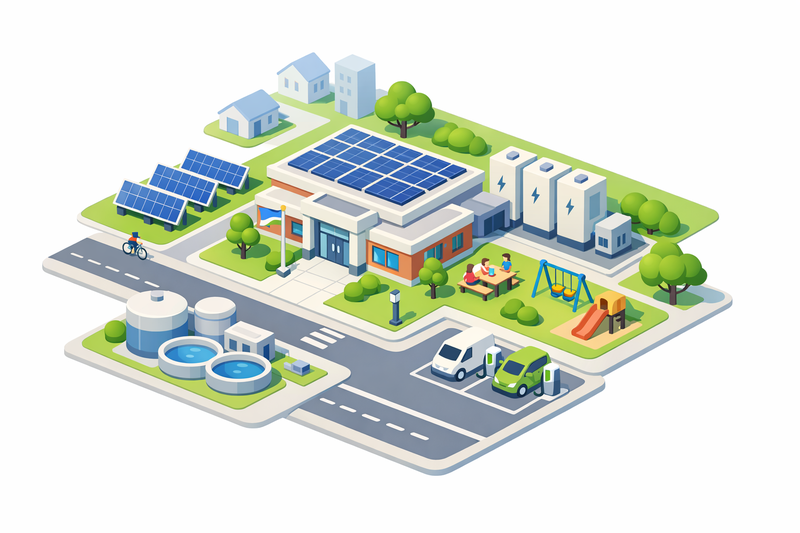
Extreme weather events are increasing in frequency and severity, exposing critical gaps in municipal energy infrastructure. When the grid goes down, communities lose water treatment, fire station operations, emergency communications, and shelter capacity—exactly when they need these services most. Meanwhile, municipalities face tight budgets and growing pressure to meet climate action plans. The solution: microgrids that serve double duty, saving money during normal operations and keeping critical facilities powered during emergencies.
Critical pain points
Why municipal resilience planning is urgent
Critical Facility Vulnerability
Fire stations, water treatment plants, police stations, and emergency shelters lose power during the same events that create the greatest demand for their services.
Tight Municipal Budgets
Local governments operate under severe budget constraints. Energy investments must demonstrate clear cost savings or be funded through grants and resilience programs.
Climate Action Mandates
Many cities and states have adopted aggressive emissions reduction targets. Municipal facilities must lead by example with clean energy adoption, often documented through energy management frameworks such as ISO 50001.
Community Equity
Energy resilience isn't just about infrastructure—it's about protecting vulnerable populations who depend on public services during emergencies.
Dual-purpose energy systems for public facilities
HOMER software enables municipal planners to design energy systems that deliver savings every day and resilience when it matters most. HOMER Grid models grid-connected public facilities for cost optimization with backup capability. HOMER Pro designs standalone or islanding microgrids for critical emergency infrastructure. Both products generate the analysis needed for grant applications, council approvals, and federal resilience funding.
Core modeling advantages
Built for confident decisions
Resilience + Savings
Model systems that reduce your facility's electricity bill during normal operations while maintaining full backup power during multi-day outages. Quantify both the annual savings and the resilience value.
Grant-Ready Analysis
Generate the techno-economic outputs required by FEMA BRIC, state resilience grants, and federal clean energy programs: lifecycle costs, emissions reduction, resilience duration, and payback analysis.
Portfolio Planning
Model multiple public facilities (fire stations, schools, water plants, shelters) to prioritise investments and develop a phased community resilience plan.
Additional Capabilities
- + HOMER Pro: For municipal utilities, remote water infrastructure, or standalone emergency power systems, design optimised off-grid or islanding-capable microgrids.
- + HOMER Grid: For grid-connected public buildings, model solar + storage against your municipal utility rate to maximise bill savings while maintaining backup capability.
- + Multi-Year module: Project system performance and savings over 20–25 year municipal planning horizons, supporting capital improvement plans and bond applications.
Use Case: Community Resilience Hub Network for a Coastal City
The Situation
A mid-size coastal city in the southeastern U.S. experienced a Category 3 hurricane that knocked out power for 8 days. Three fire stations lost backup power on day 2. The city's designated emergency shelters had no generation at all. The city council has allocated $5M in FEMA BRIC grant matching funds and directed the public works department to design a network of resilient community hubs that can sustain operations for 14 days without grid power.
What Was Modeled
Using HOMER Grid and HOMER Pro, the city's engineering consultant modeled 6 critical facilities: 3 fire stations, 2 community centres/emergency shelters, and the water treatment plant. Each facility's load was profiled and separated into critical, priority, and deferrable categories. Configurations combining rooftop/carport solar, battery storage, and either natural gas or propane generators were evaluated. Resilience scenarios tested 7-day and 14-day outages during both summer and winter conditions.
The Outcome
The optimised resilience hub network: solar + BESS + generator at each of the 6 facilities, with total project cost of $8.2M ($5M FEMA + $3.2M city match). During normal operations, the combined systems save the city $620,000 annually in electricity costs. During a 14-day outage, all 6 facilities maintain full critical operations. The HOMER analysis formed the core of the FEMA BRIC application, which was approved.
Real-World Applications
| Location / Client | Project Type | Key Result |
|---|---|---|
| Community Centre, Colorado | Municipal microgrid providing resilience + grid services for public facility | Operational case proving dual-value municipal microgrid model |
| Remote Village | Solar + storage microgrid replacing damaged distribution for remote community | Utility + municipality partnership using HOMER-modeled renewables |
| Guard Facility | Solar + long-duration storage for public emergency facility | Earthquake/tsunami preparedness driving municipal resilience investment |
| City and County Resilience Programs | Growing adoption of FEMA BRIC-funded community microgrids | HOMER analysis supporting successful federal grant applications |
Recommended HOMER Products
HOMER® Grid + HOMER® Pro
Community resilience, optimised
HOMER Grid models grid-connected public facilities for cost savings + backup. HOMER Pro designs standalone emergency power systems and islanding microgrids. Together, they cover every municipal resilience scenario—from fire stations to water treatment plants.
Key Modules: Multi-Year, Advanced Load, Advanced Storage, Advanced Grid
Supporting Services
Advisory Services
UL Solutions engineers provide independent feasibility analysis for grant applications, municipal capital improvement plans, and community resilience strategies.
Learn More →Training
HOMER training for municipal energy staff and public works departments. Build in-house capacity for ongoing energy planning and grant applications.
Learn More →Regional focus
Government-led energy transition programmes span EU energy communities, rural electrification mandates, and Asia-Pacific climate finance. Each region has distinct policy instruments and procurement frameworks.
Selected HOMER research
View full bibliography →Studies that used HOMER to inform energy policy, incentives, and distributed generation planning, drawn from the bibliography of 1,000+ publications.
-
Nodal Pricing in Ontario, Canada: Implications for Solar PV Electricity
Brown, S.J. & Rowlands, I.H. (2009). Renewable Energy, vol. 34(1).
-
Assessing the Potential for a Wind Power Incentive for Remote Villages in Canada
Weis, T.M. & Ilinca, A. (2010). Energy Policy, vol. 38(10).
-
Optimization of Distributed Energy System and Benefit Analysis of Energy Saving and Emission Reduction
Lei, J., Xie, J. & Gan, D. (2009). Automation of Electric Power Systems, vol. 33(23).
Ready to protect your community's critical services?
HOMER software provides the rigorous analysis municipalities need to secure resilience funding, justify investments to councils, and ensure public facilities stay operational when communities need them most. Request a demo or talk to our public sector team.