Grid-connected — HOMER Grid
Cut your facility's electricity bill—without cutting reliability
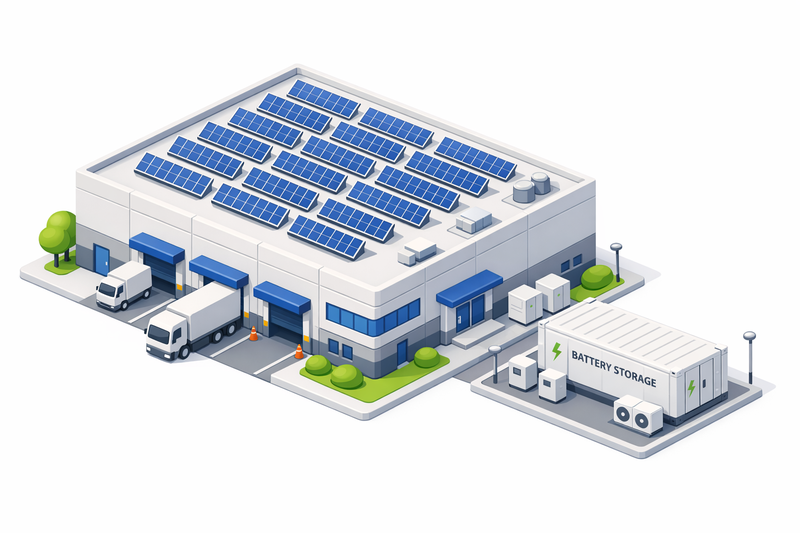
HOMER Grid models the optimal combination of solar, battery storage, and demand management for your facility—maximising savings on demand charges, time-of-use rates, and energy arbitrage while ensuring backup power when the grid goes down.
Demand charges are eating your energy budget
For many commercial and industrial facilities, demand charges—based on your peak 15-minute power draw in a billing period—account for 30–50% of the total electricity bill. A single spike from starting a production line, running HVAC on a hot afternoon, or charging an EV fleet can set your demand charge for the entire month. Meanwhile, grid outages cost U.S. businesses an estimated $150 billion annually in lost productivity. The solution: on-site solar and storage, optimised to shave peaks and keep your facility running when the grid fails.
Critical pain points
Why C&I electricity costs stay unpredictable
Demand charge pain
A single 15-minute demand spike can set your bill for the entire month. Demand charges of $15–30/kW mean even moderate peaks cost thousands per month.
Complex rate structures
Time-of-use rates, tiered pricing, ratchet clauses, and NEM 3.0 rules make it nearly impossible to manually determine the best solar + storage strategy.
Grid outage exposure
Extended outages halt production, spoil inventory, and disrupt operations. Backup generators are expensive, polluting, and often insufficient.
Sustainability mandates
Corporate ESG commitments and customer expectations increasingly require facilities to reduce carbon footprints and demonstrate clean energy adoption—often through formal frameworks like ISO 50001.
Behind-the-meter optimization that pays for itself
HOMER Grid is purpose-built for grid-connected commercial and industrial facilities. It models your facility's load profile against your actual utility tariff—including demand charges, time-of-use rates, net metering policies, and export limits—to find the solar + storage configuration that delivers the highest financial return while meeting your resilience and sustainability goals.
Core modeling advantages
Built for confident decisions
Tariff-Aware Optimization
Import your exact utility rate structure (or select from HOMER's database of 50,000+ U.S. tariffs). HOMER Grid optimises system dispatch against every rate component: energy charges, demand charges, TOU periods, and NEM rules.
Demand Charge Management
HOMER Grid's dispatch algorithm specifically targets peak demand reduction—the highest-value savings opportunity for most C&I facilities. See exactly how much each kW of battery capacity saves.
Resilience + Economics
Don't choose between savings and backup power. HOMER Grid models systems that deliver daily economic value through peak shaving and arbitrage while maintaining battery reserve for grid outages.
Additional Capabilities
- +EV charging integration: Model the impact of on-site EV chargers on your demand profile. Optimise solar + storage to buffer charging loads and avoid demand charge spikes.
- +NEM 3.0 / net billing: California's NEM 3.0 and similar policies make solar export far less valuable. HOMER Grid models self-consumption optimization with storage to maximise savings under new rules.
- +Incentive modeling: Factor in federal ITC, state incentives, MACRS depreciation, and demand response program revenues to calculate true project economics.
Use Case: Solar + storage for a manufacturing plant
The Situation
A mid-size food manufacturing plant in Southern California pays $480,000 annually for electricity, with demand charges accounting for 42% of the bill ($200,000/year). The facility's peak demand of 1.8 MW occurs during a 2-hour overlap of production, cold storage compressors, and afternoon HVAC. The company has committed to 50% renewable energy by 2030. Under California's NEM 3.0, the economics of solar-only have deteriorated, making storage essential.
What Was Modeled
Using HOMER Grid, the facility's energy consultant imported actual 15-minute interval load data and the plant's SCE TOU-GS-3 tariff. They modeled combinations of 200–600 kW rooftop solar, 250–1,000 kWh battery storage, and various dispatch strategies. Federal ITC at 30%, MACRS depreciation, and the local SGIP incentive were included in the financial model.
The Outcome
Optimal design: 450 kW rooftop solar + 600 kWh / 250 kW battery storage. Annual electricity bill reduction: $185,000 (39%), with $120,000 from demand charge reduction and $65,000 from TOU arbitrage and self-consumption. The system achieves 35% renewable energy for the facility, with a 4.8-year simple payback after incentives. During outages, the battery provides 4 hours of backup for critical cold storage loads. Project IRR: 22%.
Real-World Applications
| Location / Client | Project Type | Key Result |
|---|---|---|
| Brewing Company, Hawaii | Solar + Tesla batteries + biodiesel microgrid | Grid independence, $300K/year savings—energy costs cut in half |
| New York organic food distributor | HOMER Grid-designed microgrid for commercial facility | Improved bottom line and resilience for metro-area business |
| Hotel, New Haven CT | Historic building converted to highly efficient hotel with HOMER Grid microgrid | Top-rated hotel combining architectural landmark with energy innovation |
| EV Stations network, California | Solar + storage EV charging convenience stations | HOMER Grid used to model integrated charging + retail energy economics |
Recommended HOMER Products
HOMER Grid
Electric bill optimization
Purpose-built for grid-connected, behind-the-meter applications. HOMER Grid understands utility tariffs, demand charges, NEM rules, and incentive programs at a depth no other tool matches. It finds the sweet spot between economic return and resilience.
Key Features: EV charging, tariff database (50,000+ U.S. rates)
Supporting Services
Advisory Services
UL Solutions engineers provide independent system design, financial analysis, and EPC bid evaluation for C&I solar + storage projects.
Learn More →Engineer Hours
Hire a HOMER specialist to build your facility model, import your rate structure, and generate the financial analysis your CFO needs for project approval.
Learn More →Regional focus
C&I energy economics and regulatory context by market.
Selected HOMER research
View full bibliography →Studies that used HOMER to model grid-connected and commercial-load hybrid systems, drawn from the bibliography of 1,000+ publications.
-
Technical and Economic Assessment of Grid-independent Hybrid Photovoltaic-diesel-battery Power Systems for Commercial Loads in Desert Environments
Shaahid, S.M. (2007). Renewable and Sustainable Energy Reviews, vol. 11(8).
-
Economic Analysis of Standalone and Grid Connected Hybrid Energy Systems
Turkay, B.E. & Telli, A.Y. (2011). Renewable Energy, vol. 36(7).
-
Energy, Economic and Environmental Analysis on RET-Hydrogen Systems in Residential Buildings
Beccali, M., Brunone, S., Cellura, M. & Franzitta, V. (2008). Renewable Energy, vol. 33(3).
Ready to take control of your electricity costs?
HOMER Grid shows you exactly how much you can save with solar and storage—against your actual tariff, your actual load, and your actual incentives. Start with a free trial or talk to our C&I energy specialists.