Grid-connected — HOMER Grid
Fast charging without the demand charge shock
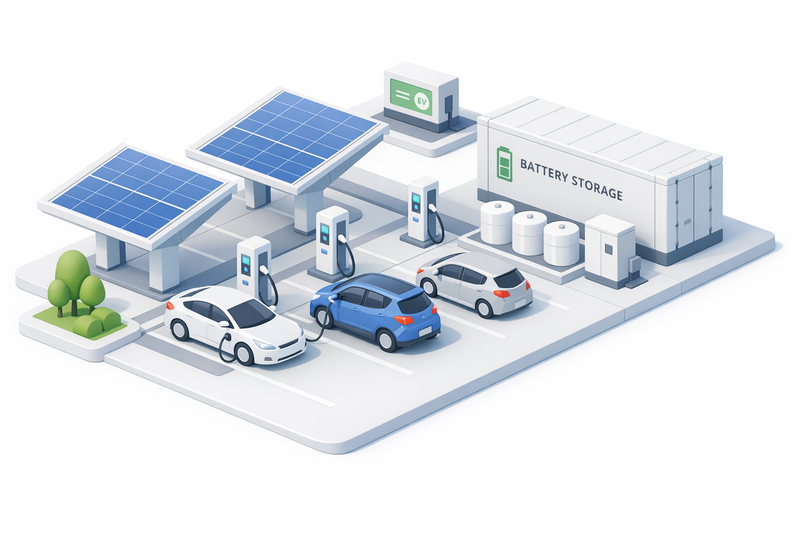
HOMER Grid models the optimal combination of solar and battery storage to support EV charging infrastructure—managing demand spikes, maximizing revenue, and ensuring your charging investment pencils out from day one.
DC fast chargers create demand charge nightmares
A single DC fast charger can draw 150–350 kW. When multiple chargers fire simultaneously, the demand spike sets your utility bill for the entire month. For many EV charging locations, demand charges represent 50–70% of the electricity cost—making charging unprofitable without mitigation. Solar canopies and battery storage can absorb the spikes, but only if the system is properly sized to balance charging demand, solar generation, and battery capacity.
Critical pain points
Why EV charging economics are hard to optimize
Extreme demand spikes
Multiple DC fast chargers firing simultaneously can create 500+ kW demand spikes in minutes. Demand charges of $15–30/kW make each spike cost thousands.
Uncertain revenue model
Charging station economics depend on utilisation, electricity costs, and charging fees. Without accurate energy cost modeling, it's hard to set profitable pricing.
Fleet scheduling complexity
Fleet depots must charge dozens of vehicles overnight within limited grid capacity. Poor scheduling creates peaks that could be avoided with storage buffering.
Grid interconnection limits
Many sites have limited utility interconnection capacity. Adding 10+ fast chargers may require expensive grid upgrades—unless local solar + storage can reduce peak demand on the interconnection.
Model the complete EV charging energy system
HOMER Grid now includes EV charging revenue modeling, enabling operators to design integrated solar + storage + charging systems that maximize profitability. The software models your charging load profile, utility tariff, solar generation, and battery dispatch to find the configuration that minimises energy costs while meeting your charging capacity requirements.
Core modeling advantages
Built for confident decisions
Charging Load Modeling
Model Level 2 and DC fast charging load profiles—including fleet scheduling patterns, public utilisation curves, and simultaneous charging scenarios. See exactly how charging demand interacts with your existing facility load.
Demand Charge Mitigation
HOMER Grid's dispatch algorithm uses battery storage to shave the demand peaks from fast charging, potentially reducing demand charges by 40–60%. Quantify the exact battery size needed to achieve your target peak reduction.
Revenue Optimization
Calculate EV charging revenue against your total energy costs (electricity + demand charges + solar/storage amortisation) to determine profitable charging rates and project ROI.
Additional Capabilities
- +Solar canopy sizing: Model the optimal solar canopy size for your charging station—balancing generation, shading for parked vehicles, and visual appeal for customers.
- +Grid upgrade avoidance: Determine whether solar + storage can keep your peak demand within existing interconnection limits, avoiding $500K–$2M grid upgrade costs.
- +Incentive stacking: Model federal ITC (30–50% for EV + clean energy), state incentives, NEVI funding, and utility demand response programs to maximize project economics.
Use Case: Solar + storage for a municipal fleet depot
The Situation
A city transit agency is electrifying its 80-bus fleet, requiring a depot charging facility with 20 x 150 kW DC fast chargers and 40 x 19 kW Level 2 chargers. The depot's existing electrical service is 2 MW, but simultaneous overnight charging of the full fleet would require 3.7 MW—triggering a $1.5M grid upgrade. The city wants to avoid the upgrade cost and minimize ongoing demand charges, while meeting a mandate for 100% clean energy at city facilities.
What Was Modeled
Using HOMER Grid, the transit agency's consultant modeled the fleet's charging schedule (staggered overnight charging, midday opportunity charging), the depot's existing building load, and the local utility's commercial TOU tariff. They evaluated combinations of 500 kW–1.5 MW solar canopy over the bus parking area, 2–8 MWh battery storage, and intelligent charge management. Scenarios tested full fleet (80 buses) and a phased approach (40 buses in year 1).
The Outcome
Optimal design: 1.2 MW solar canopy + 5 MWh / 1.5 MW battery + staggered charge scheduling. The battery buffers peak charging demand, keeping the site within its existing 2 MW interconnection—eliminating the $1.5M grid upgrade entirely. Annual electricity cost for fleet charging: $680,000 (vs. $1.1M without solar/storage, a 38% reduction). Solar generation covers 35% of annual charging energy. The HOMER analysis was included in the city's federal NEVI and state Clean Transportation funding applications.
Real-World Applications
| Location / Client | Project Type | Key Result |
|---|---|---|
| EV Charging Stations, California | HOMER Grid used to model solar + storage + EV charging convenience stations | Integrated energy + charging revenue optimization |
| HOMER Grid EV feature | New HOMER Grid release enabling EV charging revenue calculation | Purpose-built for the intersection of DER and electric transportation |
| European retailer fleet depot | EV fleet depot with expanded solar + storage | Demonstrates market need for integrated EV + DER planning tools |
| Municipal transit agencies | Transit fleet electrification with solar + storage depots | HOMER Grid increasingly used for fleet depot energy planning |
Recommended HOMER Products
HOMER Grid
Electric bill optimization
HOMER Grid's EV charging module models the complete energy system: charging loads, solar generation, battery dispatch, and utility tariff interaction. Its demand charge optimization algorithm directly addresses the #1 cost challenge for EV charging infrastructure.
Key Features: EV charging revenue, tariff database (50,000+ U.S. rates)
Supporting Services
Advisory Services
Independent design and financial analysis for EV charging + solar + storage projects. UL Solutions engineers help developers, fleet operators, and cities build bankable business cases.
Learn More →Engineer Hours
Hire a HOMER specialist to model your fleet charging profile, evaluate grid upgrade alternatives, and optimise your solar + storage configuration.
Learn More →Regional focus
EV charging infrastructure and regulatory context by region.
Selected HOMER research
View full bibliography →HOMER has been used to model solar-and-storage-supported electric mobility systems, drawn from the bibliography of 1,000+ publications.
-
Solar-assisted Electric Auto Rickshaw Three-wheeler
Mulhall, P., Lukic, S.M., Wirasingha, S.G., Lee, Y.J. & Emadi, A. (2010). IEEE Transactions on Vehicular Technology, vol. 59(5).
-
Solar/battery electric auto rickshaw three-wheeler
Mulhall, P., Lukic, S.M., Wirasingha, S.G., Lee, Y. & Emadi, A. (2009). 5th IEEE Vehicle Power and Propulsion Conference.
Ready to build a profitable, clean EV charging facility?
HOMER Grid shows you exactly how solar and storage can tame demand charges, avoid grid upgrades, and make your EV charging investment profitable. Start with a free trial or talk to our EV energy specialists.