Off-grid & Remote — HOMER Pro + HOMER Grid
Mission-critical energy resilience for military installations
HOMER software helps defense organisations design microgrids that reduce fuel logistics vulnerability, ensure uninterrupted power for critical operations, and meet federal energy mandates—from permanent installations to forward operating bases.
Energy is a strategic vulnerability: every gallon of fuel is a logistics risk
Military installations and deployed forces depend heavily on diesel generators, creating a critical logistics burden. The U.S. DoD is the world's largest institutional energy consumer, and fuel convoys in theatre remain a top force protection concern. Simultaneously, federal mandates require installations to achieve energy resilience, reduce fossil fuel dependence, and meet net-zero targets. Balancing mission readiness with sustainability goals demands rigorous energy system analysis.
Critical pain points
Why legacy energy puts readiness at risk
Force protection risk
Fuel convoys are high-value targets. Reducing fuel demand directly reduces the number of convoys needed, decreasing exposure to IEDs and ambushes in theatre.
Installation resilience gaps
Military bases face growing threats from extreme weather, cyberattacks on the grid, and physical attacks on energy infrastructure. Extended grid outages can compromise mission readiness.
Federal mandates
Executive orders and DoD directives require installations to meet energy resilience, renewable energy, and net-zero targets—with reporting deadlines and compliance obligations. Many installations also pursue formal energy management frameworks like ISO 50001.
Budget constraints
Military construction budgets are limited. Energy investments must demonstrate clear return on investment and operational value to compete for funding.
Proven microgrid modeling for defense energy planning
HOMER software is used by the U.S. military, NATO partners, and defense contractors worldwide to design energy-resilient installations. From permanent CONUS bases to forward operating bases, HOMER models hybrid power systems that balance mission requirements, budget constraints, and policy mandates.
Core modeling advantages
Built for confident decisions
Resilience Modeling
Simulate grid outage scenarios—from hours to weeks—to verify that your microgrid keeps critical loads powered. Test islanding capability, generator fuel reserves, and battery autonomy under realistic conditions.
Multi-Threat Analysis
Use sensitivity analysis to stress-test designs against fuel supply disruption, extreme weather impacts on solar/wind output, and load surges from emergency operations.
Total Lifecycle Cost
Evaluate complete system economics including capital, O&M, fuel, and avoided costs from resilience. Generate the financial analysis needed for military construction (MILCON) budget justification.
Additional Capabilities
- +HOMER Grid: For grid-connected installations, model behind-the-meter solar + storage to reduce demand charges and maintain islanding capability during outages.
- +Advanced Storage: Model battery systems accurately under diverse climatic conditions—desert installations, Arctic bases, and tropical deployments.
- +Advanced Load: Separate critical, priority, and deferrable loads to ensure mission-essential systems are always served first during constrained operations.
- +Multi-Year module: Project system performance across the installation's planning horizon, accounting for load growth, equipment aging, and policy changes.
Use Case: Energy resilience for a CONUS military installation
The Situation
A U.S. Army installation in the southeastern United States has been directed to achieve 14-day energy resilience for critical missions per DoD Installation Energy Plans. The base currently draws 15 MW peak from the local utility grid, with aging backup diesel generators covering only 40% of critical loads for 72 hours. Recent hurricanes have caused multi-day grid outages, forcing the base to curtail non-essential operations.
What Was Modeled
Using HOMER Grid and HOMER Pro, the base energy team modeled the installation's detailed load profile—separating critical mission loads (command, communications, hospital, weapons storage) from priority and deferrable loads. They evaluated combinations of 2–5 MW solar PV, 5–20 MWh battery energy storage, natural gas generators, and the existing diesel fleet. Resilience scenarios tested 3-day, 7-day, and 14-day grid outages under both summer peak and winter conditions.
The Outcome
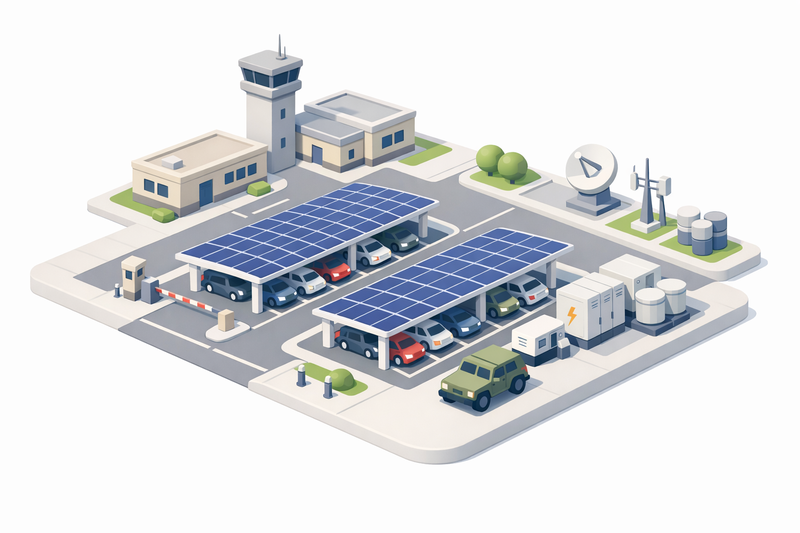
The recommended design: 4 MW solar carports + 15 MWh battery + 2 new natural gas generators + retained diesel fleet for emergency backup. During normal operations, the system reduces the base's annual electricity costs by $1.8M. During a 14-day grid outage, the microgrid sustains all critical and priority loads indefinitely. The HOMER analysis formed the core of the installation's MILCON funding request, which was approved for the next fiscal year.
Recommended HOMER Products
HOMER Pro + HOMER Grid
Resilience from installation to forward edge
HOMER Pro designs off-grid and islanded power systems for FOBs and remote installations. HOMER Grid optimises grid-connected base microgrids for cost savings and resilience. Together, they cover the full spectrum of defense energy planning needs.
Key Modules: Advanced Storage, Advanced Load, Multi-Year, Advanced Grid
Supporting Services
Advisory Services
Independent engineering analysis for MILCON funding requests, resilience assessments, and Energy Resilience Readiness Exercise (ERRE) support. UL Solutions engineers deliver the documentation DoD requires.
Learn More →Training
HOMER training sessions for base energy managers and defense contractor teams. Available as on-site workshops or virtual sessions, tailored to military energy planning workflows.
Learn More →Regional focus
Defence energy mandates, NATO standards, and austere-environment microgrids span Europe and the Indo-Pacific. Explore regional contexts where HOMER's military modelling capabilities are most active.
Selected HOMER research
View full bibliography →HOMER is widely used to model off-grid energy resilience and remote power assurance. These references illustrate remote and backup power modelling; browse the bibliography for the full body of work.
-
Analysis of Electric Loads and Wind-diesel Energy Options for Remote Power Stations in Alaska
Devine, M. (2004). Masters Thesis, University of Massachusetts Amherst.
-
Feasibility and Sensitivity Analysis of Hybrid Energy Systems for Uninterrupted Power Supply
Rawat, R. (2013). Dissertation, National Institute of Technology Hamirpur.
-
Computer Modeling of Renewable Power Systems
Lilienthal, P.D., Lambert, T.W. & Gilman, P. (2004). Encyclopedia of Energy, NREL Report CH-710-36771.
Ready to strengthen your installation's energy resilience?
From permanent installations to deployed forces, HOMER software provides the rigorous analysis needed to justify energy investments, meet federal mandates, and protect mission readiness.