Diverse, complex loads
Labs, data centres, dormitories, and athletic facilities each have radically different load profiles, schedules, and critical power needs. One-size-fits-all approaches fail.
Planning complexity
Grid-connected — HOMER Grid + HOMER Pro
HOMER software helps universities and institutional campuses design integrated energy systems—combining solar, CHP, battery storage, and intelligent grid interaction to hit net-zero targets while reducing energy costs.
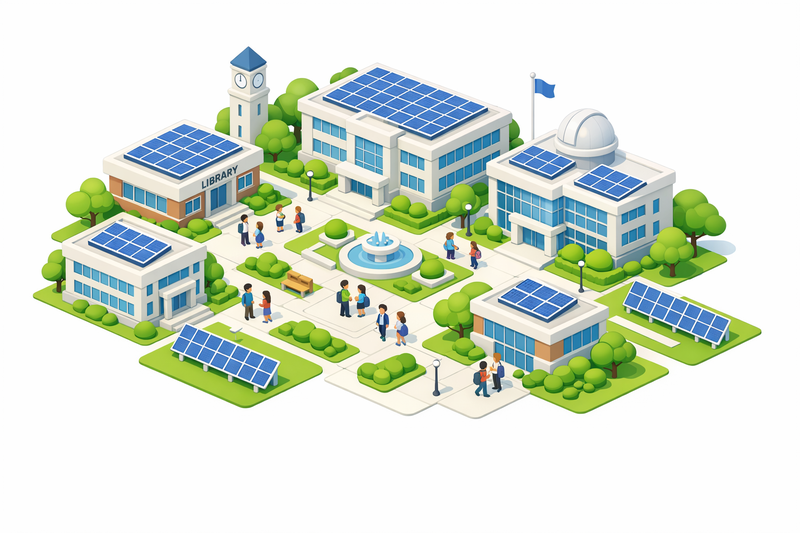
A university campus has dozens of building types (labs, dormitories, lecture halls, athletic facilities), diverse load profiles, and often its own distribution system. Energy budgets of $10–50M+ annually are common. Meanwhile, institutional boards and student bodies are demanding aggressive carbon neutrality timelines. Designing a campus energy system that balances sustainability ambitions, budget reality, resilience needs, and operational complexity requires sophisticated modeling.
Critical pain points
Universities must optimize across competing priorities, aging infrastructure, and pressure for visible decarbonization results.
Labs, data centres, dormitories, and athletic facilities each have radically different load profiles, schedules, and critical power needs. One-size-fits-all approaches fail.
Planning complexity
Net-zero by 2035 or 2040 commitments are common. Boards and students demand visible progress, but the path from commitment to implementation requires detailed analysis.
Decarbonization pressure
Higher education budgets are under pressure. Energy investments must compete with academic priorities and demonstrate clear financial return or avoided cost.
Budget scrutiny
Many campuses have district heating/cooling systems. Optimizing across both electrical and thermal energy domains is essential but analytically complex.
Multi-domain optimization
HOMER software provides the techno-economic modeling universities need to plan their energy transition. HOMER Grid optimises behind-the-meter solar + storage + CHP against your utility tariff. HOMER Pro designs any off-grid or islanding-capable microgrid components. Together, they model the full campus energy system—electrical and thermal—to find the path that meets your carbon goals at the lowest lifecycle cost.
Core modeling advantages
From CHP dispatch to phased investments, HOMER gives facilities and finance teams one shared analytical baseline.
Model diverse building loads, central plant operations, and distributed generation in a unified analysis. Account for seasonal variation (academic calendar, summer research, break periods).
Unified decision model
For campuses with district heating or cooling, model combined heat and power systems that dramatically improve total energy efficiency and reduce both electricity costs and heating fuel consumption.
Thermal-electric efficiency
Use Multi-Year analysis to plan a staged energy transition: solar in year 1, battery storage in year 3, CHP upgrade in year 5. Show the cumulative cost and carbon impact of each phase.
Roadmap confidence
A 30,000-student state university spends $28 million annually on electricity and natural gas. The campus has a central CHP plant (aging and due for replacement), 45 buildings, and a board resolution requiring carbon neutrality by 2040. Current renewable energy: a 500 kW demonstration solar array. The facilities team needs a credible, phased roadmap showing how to get from 2% renewable energy today to net-zero within 15 years, with clear cost projections that the board can approve.
Using HOMER Grid and HOMER Pro with the CHP module, the university's energy consultant modeled the entire campus: building-by-building load profiles, existing CHP output, district heating demand, and grid electricity consumption. They evaluated a phased approach: Phase 1 (years 1–3): 5 MW distributed solar + 4 MWh battery. Phase 2 (years 4–6): new 3 MW high-efficiency CHP system. Phase 3 (years 7–10): additional 3 MW solar + 8 MWh storage + building electrification. Multi-Year analysis projected performance through 2040.
The roadmap achieves 75% carbon reduction by 2035 and net-zero by 2039. Total investment: $42M over 15 years. Net present value of energy savings: $58M—a positive ROI that funds the transition with utility cost avoidance. Phase 1 alone saves $3.2M annually and reduces carbon by 22%. The new CHP in Phase 2 adds $4.1M in annual savings through combined electrical and thermal efficiency. HOMER's analysis was presented to the Board of Regents and approved as the university's official Campus Energy Master Plan.
| Location / Client | Project Type | Key Result |
|---|---|---|
| Fort Collins community centre | Municipal microgrid with resilience + grid services—applicable campus model | Demonstrates phased implementation of distributed energy on public facilities |
| Campus microgrid | One of the most advanced campus microgrids in the U.S. | CHP + solar + storage serving 450 buildings—demonstrates campus-scale feasibility |
| University research using HOMER | 1,000+ peer-reviewed papers using HOMER Pro for campus energy analysis | Tool of choice in university energy engineering departments worldwide |
| University | Major universities adopting campus energy planning software | Validates market demand for campus-scale DER optimization tools |
Campus energy transformation
HOMER Grid optimises grid-connected campus systems with CHP and tariff-aware dispatch. HOMER Pro designs resilient microgrids for critical campus facilities. The CHP module—essential for campuses with district heating/cooling—is a unique HOMER strength.
Key Modules: Combined Heat & Power, Multi-Year, Advanced Load, Advanced Storage
Campus Energy Master Plan development with UL Solutions engineers. Includes phased implementation roadmap, financial modeling, and board presentation materials.
Learn More →Train your campus energy team on HOMER software. Popular with university facilities departments and engineering faculty who want to use HOMER in coursework.
Learn More →University campus microgrids are a growing priority across China's dual-carbon target institutions, European net-zero campuses, and India's smart campus initiatives.
Studies and theses that used HOMER to model campus and university microgrids, drawn from the bibliography of 1,000+ publications.
Maity, A. & Pattanayak, P. (2025).
Krishna, K.M. (2014).
Onovughe, E.C. (2025). Novia University of Applied Sciences, Finland.
HOMER software provides the analytical foundation for campus energy transformation—from the first rooftop solar array to full net-zero. Start with a free trial or talk to our campus energy specialists.