Off-grid & Remote — HOMER Pro
Electricity changes everything—design it right from the start
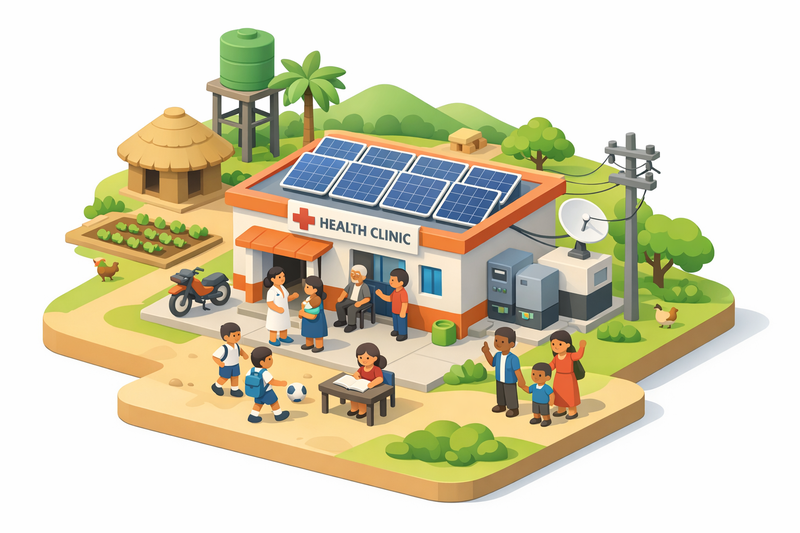
HOMER Pro helps development organisations and NGOs design affordable, reliable microgrids for the communities that need them most—from rural health clinics and schools to refugee settlements and agricultural cooperatives.
770 million people still lack access to electricity
Despite dramatic progress, hundreds of millions of people—concentrated in Sub-Saharan Africa and South Asia—still live without electricity. For rural health clinics, this means vaccine cold chains are broken. For schools, it means no lights and no computers. For communities, it means limited economic opportunity. Off-grid microgrids are the fastest, most cost-effective path to electrification for these populations, but designing a system that is both affordable and reliable for decades requires rigorous analysis.
Critical pain points
Why project design quality determines impact
Lives depend on power
Rural health clinics need reliable electricity for vaccine refrigeration, surgical lighting, diagnostics, and communications. A poorly designed system that fails costs lives.
Extremely tight budgets
Grant-funded projects must maximise every dollar. Oversizing a system wastes scarce resources; undersizing means the community outgrows it within years.
Long-term sustainability
Many donor-funded microgrids fail within 5 years because they weren't designed for local maintenance, load growth, or component replacement. Sustainability must be engineered in.
Donor reporting requirements
Development finance institutions and bilateral donors require detailed techno-economic analysis to approve funding. Grant applications need bankable feasibility studies.
Rigorous design tools for the world's most important energy projects
HOMER Pro was originally created at the U.S. National Renewable Energy Laboratory for exactly this purpose—designing affordable, reliable power systems for communities without grid access. It remains the gold standard for rural electrification planning, with over 1,000 peer-reviewed publications and adoption by major development agencies worldwide. HOMER gives you the analysis to design systems that work today and sustain for decades.
Core modeling advantages
Built for confident decisions
Right-Sized Design
Avoid both oversizing (wasting budget) and undersizing (future failures). HOMER evaluates thousands of configurations to find the exact system that meets your community's needs at the lowest lifecycle cost.
Local Resource Matching
Import site-specific solar, wind, and hydro resource data. HOMER's built-in resource databases and NASA data integration mean you can model any location on Earth accurately.
Grant-Ready Reporting
Generate the techno-economic outputs that development banks and donors require: LCOE, net present cost, cash flows, fuel savings, CO₂ reduction, and sensitivity analysis.
Additional Capabilities
- +Multi-Year module: Project how the system performs as the community grows. Model 2–5% annual load growth, battery replacements, and panel degradation over a 20–25 year project life.
- +Hydro module: Many rural communities have stream resources. Model small and micro hydro alongside solar and storage for least-cost hybrid design.
- +Biomass module: For agricultural communities, model biogas from animal waste or crop residues as a generation source alongside solar.
- +Advanced Load: Separate critical loads (health clinic, water pumping) from deferrable loads (community lighting, productive use) to ensure essential services are always powered.
Use Case: Powering a cluster of rural health clinics in Southeast Asia
The Situation
An international NGO is electrifying 12 rural health clinics across a remote province in Myanmar. The clinics currently have no reliable electricity. Vaccine cold chains are broken, and surgical procedures can only be performed during daylight hours. The NGO has secured a $1.2M grant from a bilateral development agency and needs to design systems that provide 24/7 power to each clinic, with a 20-year design life and provisions for community load growth.
What Was Modeled
Using HOMER Pro, the project engineer modeled each clinic's current and projected load profile (medical equipment, lighting, vaccine refrigerators, communications, staff housing). Site-specific solar data was imported for each of the 12 locations. HOMER evaluated configurations combining 3–10 kW solar PV, 10–40 kWh batteries, and a small backup diesel generator. The Multi-Year module projected performance over 20 years with 3% annual load growth and battery replacements at years 8 and 16.
The Outcome
HOMER identified optimised designs for each clinic, ranging from 5–8 kW solar + 20–35 kWh battery + 3 kW diesel backup. Average LCOE across the 12 sites: $0.28/kWh—well within the grant budget. Renewable penetration averages 92%, with diesel running only during extended monsoon cloud cover. The HOMER report satisfied the development agency's due diligence requirements, and the $1.2M grant was disbursed. Three years after installation, all 12 clinics report 99.7% uptime.
Real-World Applications
| Location / Client | Project Type | Key Result |
|---|---|---|
| School, Malawi | Engineers Without Borders solar microgrid for rural school | Students gained electricity for lights and electronics for the first time |
| Community center, Nairobi | Microgrid powering clean water, showers, laundry, internet, classrooms | Providing hope and job training in one of Africa's largest informal settlements |
| Nepal rural school | Engineers Without Borders Germany repowered school with new microgrid | Lightning protection and power resilience for remote education |
| Community, Nigeria | PowerGen “under the grid” minigrid for rural community | Renewable power during daytime complementing utility supply at night |
Recommended HOMER Products
HOMER Pro
Self-sufficiency and resilience
The global standard for off-grid microgrid design, trusted by development agencies, NGOs, and rural electrification programmes worldwide. HOMER Pro's NREL heritage, academic credibility, and ease of use make it the natural choice for development projects that must be both affordable and bankable.
Key Modules: Multi-Year, Hydro, Biomass, Advanced Load, Advanced Storage
Supporting Services
Training
Group training sessions for NGO teams and local engineers—ensuring in-country capacity to design and maintain microgrid systems long after the project ends.
Learn More →Engineer Hours
Hire a HOMER specialist to support your project design, review system configurations, or help prepare grant application materials with robust techno-economic analysis.
Learn More →Regional focus
Development and humanitarian electrification contexts by region.
Selected HOMER research
View full bibliography →Peer-reviewed studies and theses on mini-grids and rural electrification in developing regions that used HOMER, drawn from the bibliography of 1,000+ publications.
-
Renewable Energy-Based Mini-Grid for Rural Electrification: Case Study of an Indian Village
Sen, R. & Bhattacharyya, S.C. (2014). In Mini-Grids for Rural Electrification of Developing Countries, Springer.
-
Demand Analysis and Optimization of Renewable Energy – Sustainable Rural Electrification of Mbanayili, Ghana
Bailey, P.N., Oracha, C.O. & Isono, S. (2007). Masters Thesis, University of Michigan.
-
Feasibility Study of Renewable Energy-based Microgrid System in Somaliland's Urban Center
Abdirahman, M.A. et al. (2014). Renewable and Sustainable Energy Reviews, vol. 40.
-
Decentralized Renewable Hybrid Mini-Grids for Sustainable Electrification of the Off-Grid Coastal Areas of Bangladesh
Alam, M. & Bhattacharyya, S. (2016). Energies, vol. 9(4).
Ready to bring reliable power to the communities that need it most?
HOMER Pro gives development organisations the rigorous analysis to design systems that last—and the bankable reports to secure the funding. Start with a free trial, or explore our training options to build capacity in your team.