See HOMER Front in Action!

Bankability & Investment-Grade Modeling
Dispatch modeling that lenders and investors can trust
Project value is no longer driven solely by energy production. It depends on market volatility, revenue stacking, storage design and the balance between long-term PPAs and merchant exposure.
HOMER® Front integrates physical system constraints, operational behavior and market participation in a single techno-economic framework — built for developers, IPPs and investors who need robust, transparent analyses to support financing decisions.
A deliberate avoidance of non-bankable assumptions. HOMER Front excludes perfect foresight of prices, frictionless arbitrage and over-optimization detached from operational reality — producing outputs that are more conservative, more stable under sensitivity analysis and more defensible in lender review.
What "bankability" means here
Bankability is the confidence lenders and investors have that a project will perform and return as expected across operating and market conditions. In technical due diligence it rests on five dimensions:
Technical robustness
Validated technologies and design, with realistic parameters — round-trip efficiency, depth of discharge, cycling limits.
Energy & performance certainty
Probabilistic energy yield (P50/P90/P99) and dispatch assumptions consistent with physical constraints.
Contractual strength
Alignment between performance guarantees and the technical assumptions in the financial model.
Financial consistency
Dispatch, revenue stacking and contracts aligned, so cash flows are achievable and contractually supported.
Regulatory & integration viability
Grid connection, curtailment risk, permitting and compliance with applicable grid codes.
Key consideration
Bankability is more than revenue projections — it is how far the technical, contractual and financial picture is collectively realistic and physically achievable.
Free technical guide
The hidden risk in BESS financial models
Many storage projects fail bankability reviews not because the technology is flawed, but because the modeling assumptions behind projected revenues cannot be defended.
This guide reveals how investors, lenders and technical advisors assess BESS dispatch models — and what separates investment-grade analysis from theoretical optimization. Inside:
- ✓Bankability requirements for BESS projects
- ✓Revenue stack validation and dispatch credibility
- ✓Battery degradation and lifecycle impacts
- ✓Technical due diligence expectations
- ✓Best practices for lender-ready modeling
Download your free copy
Complete the form and we'll email you a download link.
HOMER Front's role in BESS dispatch modeling
HOMER Front sits at the intersection of engineering reality and market value — co-optimizing across energy arbitrage, ancillary services and contractual delivery, while embedding every key technical constraint directly into the optimization:
Degradation-aware dispatch
Cycle- and calendar-based degradation, efficiency evolution and augmentation needs capture the trade-off between short-term revenue and long-term asset value.
System-level integration
Coupling BESS operation with renewable generation, EMS control and grid-export constraints keeps dispatch profiles technically feasible — not just economically optimal.
Key differentiation: HOMER Front does not simply estimate potential revenues. It ensures dispatch assumptions are technically feasible, internally consistent and aligned with the physical behavior of the asset across its lifetime.
A fundamentally different methodology
Conventional co-optimization
Full co-optimization can maximize arbitrage on paper — but relies on perfect price foresight and unconstrained market access, producing optimistic yet fragile outcomes that rarely hold in real operation.
The HOMER Front approach
Markets are optimized independently, then reconciled under unified physical constraints. This eliminates "hindsight-driven" trading and keeps every dispatch decision feasible — prioritizing robustness and bankability over theoretical returns.
Market modeling framework
HOMER Front supports day-ahead and real-time energy markets, ancillary services, capacity markets and contractual obligations such as PPAs — governed by a few deliberate principles:
Independent market representation — each market is modeled on its own, avoiding unrealistic co-optimization artifacts.
Absence of perfect foresight — decisions use forward-looking but uncertain information, preventing artificial arbitrage.
Deterministic reconciliation — outcomes are physically consistent, eliminating virtual or non-realizable trades.
Exposure-based participation — explicit commitment caps reflect real contractual limits, not continuous blending.
Renewable resource treatment — generation is non-dispatchable and deterministically allocated to physical profiles.
A two-layer rolling-horizon optimization engine
Layer 1 — Forward optimization (48 h)
A simplified battery representation efficiently identifies candidate dispatch strategies and short-term market opportunities.
Layer 2 — Detailed execution (24 h)
A high-fidelity physical model applies full constraints, degradation and efficiency losses to produce feasible decisions.
Executed iteratively across the project lifetime, the engine generates a very large number of dispatch decisions — pairing computational scalability with engineering accuracy for both rapid development and rigorous lender validation. Inputs flow through independent market optimization, deterministic reconciliation and a physical-operation layer to financial outputs (cash flows, IRR, NPV) — every step strictly constrained, deterministic and reproducible.
Transparency and auditability
Comprehensive data access
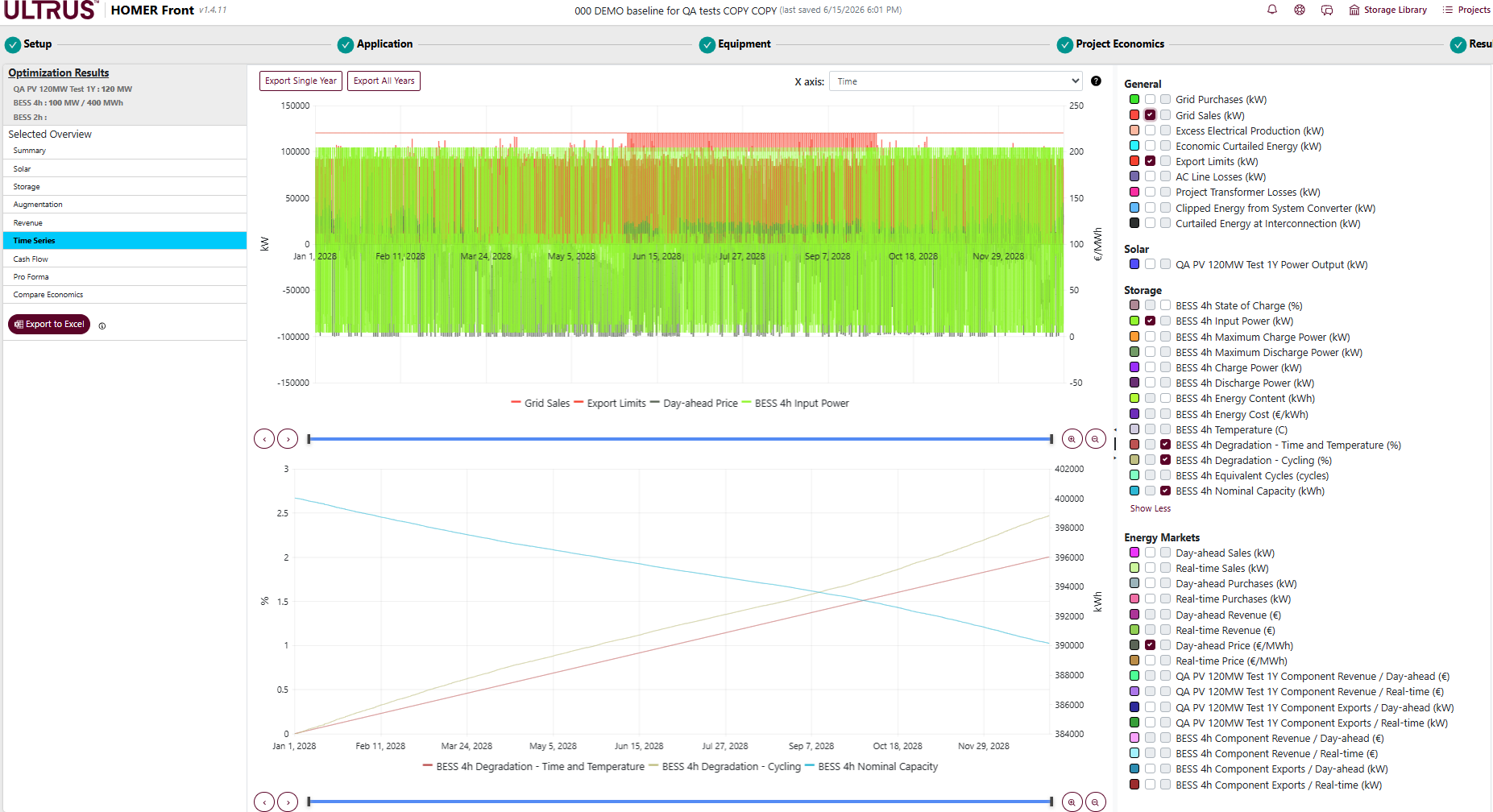
Full high-resolution time series across the lifetime — dispatch, SOC evolution, revenues and curtailment.
Full reproducibility
Complete export of data and model configurations lets lenders and independent engineers reconstruct and verify results.
Traceable assumptions
A full record of constraints, parameters and logic — auditable, with no hidden assumptions or "black-box" behavior.
Why dispatch modeling needs technical scrutiny
Dispatch assumptions drive both project revenues and long-term asset performance — yet they are too often treated as a purely commercial exercise.
Market Advisor
Provides price forecasts, market-participation strategies and the revenue stack — and often builds the dispatch model feeding the financial model.
Lender's Technical Advisor
Validates technical assumptions against system design, contracts and operational constraints — though detailed dispatch simulation often sits outside its formal scope.
In reality, BESS dispatch is inherently multidisciplinary: battery physics, EMS control logic, system integration and contractual limits decisively shape achievable strategies and revenues. That argues for stronger technical involvement — direct participation of the Technical Advisor, or at minimum a structured validation of cycling profiles, degradation consistency and contractual alignment.
Recommendation: given the immaturity and variability of current BESS dispatch methodologies, an independent second layer of technical review is warranted — especially for projects with significant merchant exposure or complex revenue stacking, where small assumption changes materially move financial outcomes.
Value for developers and IPPs
Accelerated development
Rapidly iterate battery sizes, dispatch strategies and revenue compositions without losing rigor.
Informed design
Optimize storage size, duration and augmentation, and weigh contracted vs merchant exposure.
Revenue stack validation
Evaluate arbitrage, ancillary services, capacity and contractual revenues in one consistent framework.
Investment readiness
Turn early concepts into investment-ready analyses with transparent, comparable assumptions.
Illustrative case study
Hybrid solar + BESS in ERCOT
A developer advancing a 200 MW solar PV plant with co-located storage (250 MW interconnection) used HOMER Front for a 25-year simulation against ERCOT nodal price forecasts, with a 10-year fixed-price PPA at $35/MWh plus merchant energy and ancillary-services participation.
100 MW / 400 MWh
Optimal storage configuration
12.4%
Blended levered IRR
+3.2 pts
IRR from merchant participation
~$380M
Valuation at financial close
The PPA provided roughly 65% revenue certainty. HOMER Front outputs were independently reviewed and accepted by both the tax-equity investor and the project-finance lender, supporting a successful financial close on schedule.
Built for credible financing decisions
HOMER Front shifts from theoretical optimization toward a framework designed for investment-grade applications — projections that are inherently more conservative yet more robust under uncertainty. The goal is not to maximize returns on paper, but to ensure projected returns are realistic, achievable and bankable.
Built on the HOMER platform — the global standard for hybrid power system analysis, used in 190+ countries by 250,000+ users — and backed by UL Solutions' independent BESS advisory, testing and certification expertise.
See HOMER Front in action
Discover how investment-grade dispatch modeling can de-risk your next utility-scale project.