Grid-connected — HOMER Grid
Five-nines uptime meets sustainability—modeled and optimized
HOMER software helps data center operators evaluate on-site solar, battery storage, and hybrid generation systems that reduce energy costs, improve power resilience, and deliver on corporate carbon-neutral commitments—without compromising the uptime your customers demand.
Data centers face a trilemma: cost, carbon, and reliability
Data centers consume 1–2% of global electricity—and that share is growing rapidly with AI workloads. Operators face simultaneous pressure to reduce energy costs (electricity is 30–40% of operating expenses), meet aggressive corporate sustainability targets (24/7 carbon-free energy), and maintain the extreme reliability their SLAs demand. On-site generation and storage can address all three, but only if the system is designed with rigorous techno-economic analysis.
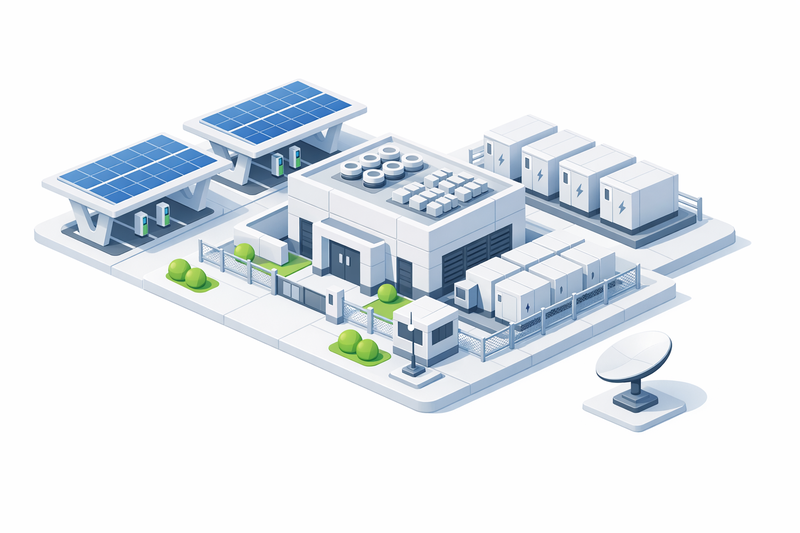
Critical pain points
Why data center energy strategy is high stakes
Electricity is the #1 OPEX
Power accounts for 30–40% of data center operating costs. Demand charges alone can represent 25%+ of the electricity bill for facilities with spiky cooling loads.
Carbon-neutral commitments
Hyperscalers and enterprise tenants increasingly require 24/7 carbon-free energy (CFE)—not just annual renewable energy credits. On-site generation is part of the answer, and formal frameworks like ISO 50001 are increasingly the documentation backbone.
Extreme uptime requirements
SLAs demand 99.999% availability. Any on-site energy system must enhance—never compromise—power reliability. Traditional backup diesel is being supplemented or replaced by BESS.
AI-driven power growth
AI training and inference workloads are driving unprecedented power density growth. New facilities need 50–100+ MW, straining grid connections and requiring on-site solutions.
Rigorous energy modeling for the world's most demanding facilities
HOMER Grid models the complex interaction between a data center's load profile, utility tariff, on-site generation (solar, fuel cells, natural gas), battery energy storage, and backup systems. It finds the configuration that minimises total cost of energy while meeting your reliability, sustainability, and power quality requirements.
Core modeling advantages
Built for confident decisions
Load Profile Analysis
Import your facility's real 15-minute interval data—including cooling load variation, IT load ramps, and maintenance windows. HOMER models the full 8,760-hour year to capture seasonal patterns.
BESS Multi-Use Modeling
Model batteries that serve multiple functions: peak demand reduction during normal operation, UPS-grade backup during outages, and energy arbitrage during off-peak hours. Quantify each revenue stream.
Grid + On-Site Co-Optimization
Evaluate the optimal mix of grid power, on-site solar, fuel cells, natural gas generation, and BESS—accounting for interconnection limits, demand charges, and carbon intensity of the grid at each hour.
Additional Capabilities
- +Advanced Load module: Separate IT loads (non-negotiable) from cooling and lighting (partially flexible) to model intelligent load management strategies.
- +HOMER Front: For utility-scale data center campuses with front-of-the-meter solar + BESS, model merchant revenue and PPA economics alongside on-site self-consumption.
- +Multi-Year module: Project system economics over the facility lifecycle, accounting for IT load growth (10–20% annually for AI-heavy sites), battery degradation, and rate escalation.
Use Case: On-site solar + BESS for a colocation data center
The Situation
A 20 MW colocation data center in Virginia's “Data Center Alley” pays $8.5 million annually for electricity. Demand charges account for $2.8M of that total, driven by cooling load spikes during summer afternoons. The operator's parent company has committed to 100% renewable energy by 2030, and enterprise tenants are increasingly asking for auditable carbon-free energy data.
What Was Modeled
Using HOMER Grid, the operator modeled actual 15-minute load data against Dominion Energy's commercial tariff. They evaluated combinations of 3–8 MW ground-mount and carport solar, 10–40 MWh lithium-ion BESS, and a natural gas fuel cell (500 kW–2 MW). Dispatch strategies were optimised for demand charge reduction, TOU arbitrage, and maintaining 2-hour BESS reserve. Federal ITC, MACRS, and Virginia Clean Economy Act incentives were modeled.
The Outcome
Optimal design: 6 MW solar + 25 MWh / 10 MW BESS + 1 MW fuel cell. Annual savings: $3.2M (38% bill reduction)—$2.1M from demand charge shaving, $700K from TOU arbitrage, and $400K from fuel cell baseload displacement. The solar + fuel cell combination covers 42% of annual energy consumption with carbon-free generation. Project IRR: 18%. The operator uses the HOMER analysis in tenant sales materials as proof of sustainability commitment.
Real-World Applications
| Location / Client | Project Type | Key Result |
|---|---|---|
| Data Center, CO | Data center operators adopting on-site solar + BESS at scale | Driven by demand charges, sustainability mandates, and grid connection constraints |
| Logistics facilities | Solar + storage for large commercial roof and ground-mount installations | Model applicable to data center campus environments |
| Fortune 500 hyperscaler | Published research on 24/7 CFE strategies incorporating on-site generation | HOMER-type analysis cited in corporate sustainability reporting |
| Global colocation providers | DER optimization for data center energy portfolios | Demonstrates market demand for tariff-depth analysis in data center planning |
Recommended HOMER Products
HOMER Grid
Electric bill optimization
HOMER Grid's tariff-aware optimization is ideal for data centers where demand charges are a dominant cost. Its ability to model multi-use BESS (economic dispatch + backup) addresses the data center's unique dual requirement of cost savings and extreme reliability.
Key Features: Advanced Load, tariff database, multi-use BESS dispatch
Supporting Services
Advisory Services
Independent system design, financial modeling, and technology evaluation for data center energy projects. UL Solutions' engineering credibility supports tenant sales and investor confidence.
Learn More →HOMER Front
For large data center campuses with utility-scale solar + BESS projects that participate in wholesale markets or structured PPAs, HOMER Front provides front-of-meter revenue optimization.
Learn More →Regional focus
Data centre energy markets and grid constraints by region.
Selected HOMER research
View full bibliography →HOMER is used to model on-site generation, storage, and backup power for high-reliability facilities. These references illustrate the reliability and methodology foundations; browse the bibliography for the full body of work.
-
Feasibility and Sensitivity Analysis of Hybrid Energy Systems for Uninterrupted Power Supply
Rawat, R. (2013). Dissertation, National Institute of Technology Hamirpur.
-
Review of software tools for hybrid renewable energy systems
Sinha, S. & Chandel, S.S. (2014). Renewable and Sustainable Energy Reviews, vol. 32.
-
Computer Modeling of Renewable Power Systems
Lilienthal, P.D., Lambert, T.W. & Gilman, P. (2004). Encyclopedia of Energy, NREL Report CH-710-36771.
Ready to optimize your data center's energy strategy?
HOMER software delivers the rigorous analysis data center operators need to balance cost, carbon, and reliability. Whether you're evaluating BESS for demand shaving, solar for sustainability targets, or both, start with a demo or talk to our energy specialists.