Grid-connected / Behind the Meter — HOMER Grid
When the grid fails, your hospital can't
HOMER software models energy systems for healthcare facilities that meet life-safety power requirements while reducing electricity costs—ensuring your hospital stays operational through any outage, any season, any scenario.
Healthcare facilities have zero tolerance for power failure
Hospitals are among the most energy-intensive buildings and the most power-critical. A mid-size hospital consumes 20–50 GWh annually, with electricity bills of $2–5 million. At the same time, life-safety codes (NFPA 110, Joint Commission standards) mandate backup power for critical systems. Traditional diesel backup generators are costly, polluting, and increasingly insufficient against multi-day grid outages from extreme weather events. Healthcare systems need a modern approach: microgrids that deliver daily economic value and reliable backup power in a single, integrated system.
Critical pain points
Why hospital energy planning is mission-critical
Life-Safety Requirements
NFPA 110 and Joint Commission standards mandate reliable backup for life-safety systems. Failure to maintain power during an outage puts patients at risk and jeopardises accreditation.
Large Energy Bills
Hospitals run 24/7 with high HVAC, lighting, and medical equipment loads. Demand charges and complex rate structures drive bills to $2–5M+ annually.
Climate Vulnerability
Extreme weather events (hurricanes, ice storms, heat waves) are causing longer, more frequent grid outages. Hospitals are designated critical facilities and must remain operational.
Aging Backup Systems
Many hospitals rely on diesel generators installed decades ago. These systems are expensive to maintain, environmentally problematic, and may not meet modern resilience requirements.
Integrated energy design for healthcare's unique demands
HOMER software addresses healthcare's dual need: reducing the ongoing cost of energy while ensuring power continuity that meets or exceeds code requirements. HOMER Grid models grid-connected hospital microgrids optimized for both economics and resilience. For rural or off-grid clinics, HOMER Pro designs standalone systems that keep critical medical equipment running 24/7.
Core modeling advantages
Built for confident decisions
Code-Aware Resilience
Simulate extended outage scenarios (72 hours, 7 days, 14 days) to verify that your microgrid keeps life-safety, critical, and equipment branch loads powered. Test against NFPA 110 and Joint Commission requirements.
Hospital Load Profiling
Model the unique 24/7 load profile of healthcare: base loads (HVAC, lighting), variable loads (OR schedules, imaging), and critical loads (ICU, NICU, pharmacy refrigeration, life support).
Combined Savings + Resilience
Optimise a system that reduces demand charges and energy costs during normal operations while maintaining battery reserve and generator capacity for outage scenarios.
Additional Capabilities
- + Combined Heat & Power module: Hospitals with large heating loads (hot water, sterilisation, space heating) can model CHP systems that capture waste heat from generators—dramatically improving total energy efficiency.
- + HOMER Pro: For rural health clinics, field hospitals, or off-grid medical facilities in developing countries, HOMER Pro designs standalone solar + battery + generator systems.
- + Multi-Year module: Model system performance over the hospital's capital planning horizon (15–25 years), accounting for load growth from expansions, equipment upgrades, and EV charging infrastructure.
Use Case: Microgrid for a Regional Medical Centre
The Situation
A 350-bed regional medical centre in the Gulf Coast region pays $3.8 million annually for electricity. The facility experienced a 4-day grid outage during a recent hurricane, depleting its diesel backup fuel supply on day 3 and forcing patient evacuation from two wings. The hospital board has mandated 7-day energy resilience for all critical and life-safety loads, while also seeking to reduce the annual electricity bill.
What Was Modeled
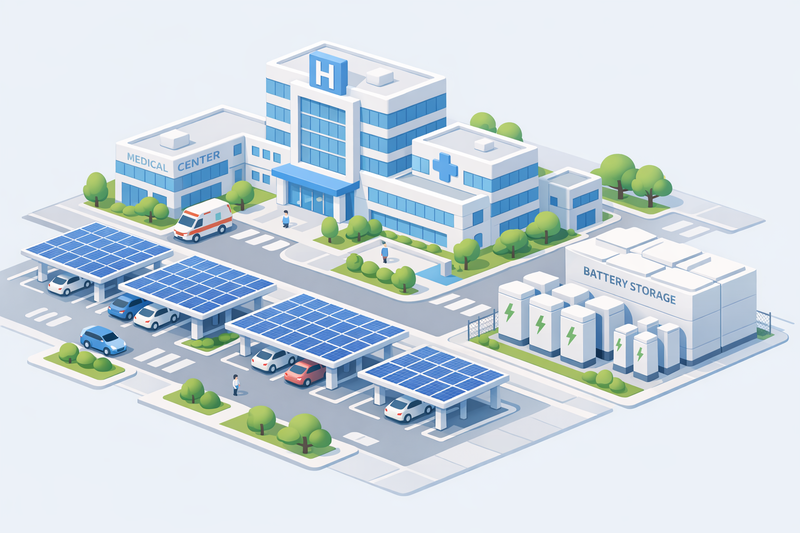
Using HOMER Grid, the hospital's MEP engineering firm modeled the facility's 15-minute interval data, separating loads into life-safety, critical, equipment, and non-essential categories. They evaluated configurations combining 1–3 MW solar canopies, 5–20 MWh BESS, a 500 kW natural gas CHP system, and the existing diesel fleet. Outage scenarios tested 3-day, 7-day, and 14-day grid failures. CHP waste heat was modeled for hot water and space heating.
The Outcome
Optimal design: 2 MW solar canopies + 12 MWh / 3 MW BESS + 500 kW natural gas CHP + retained diesel fleet. During normal operations, the system saves $920,000 annually (24% bill reduction). During a 7-day outage, the microgrid sustains all life-safety and critical loads indefinitely with the CHP and BESS. No patient evacuation would be needed. The HOMER analysis was used to secure a $12M bond for the project, with energy savings covering debt service.
Real-World Applications
| Location / Client | Project Type | Key Result |
|---|---|---|
| Gulf Coast hospital (representative) | Hospital microgrid designed for hurricane resilience | Extended outage capability beyond diesel-only backup |
| Community center | Municipal microgrid model applicable to critical facilities | Resilience + grid services dual-use design pattern |
| Healthcare industry trend | Growing adoption of hospital microgrids post-hurricanes and wildfires | Hospitals increasingly mandating 7+ day resilience |
Recommended HOMER Products
HOMER® Grid + HOMER® Pro
Life-safety power, optimised
HOMER Grid models grid-connected hospital microgrids with tariff-aware optimization and resilience testing. HOMER Pro handles off-grid rural health clinics. Together, they cover the full spectrum of healthcare energy design—from large medical centres to remote field hospitals.
Key Modules: Combined Heat & Power, Advanced Load, Multi-Year, Advanced Storage
Supporting Services
Advisory Services
Independent engineering analysis for hospital microgrid feasibility, bond applications, and code compliance review. UL Solutions credibility supports healthcare board and investor confidence.
Learn More →Engineer Hours
Hire a HOMER specialist to model your hospital's complex load profile, CHP integration, and multi-scenario resilience requirements.
Learn More →Regional focus
Healthcare energy resilience is most critical in regions with unreliable grids and high climate exposure. Sub-Saharan Africa, South Asia, and emerging markets present the highest urgency — and the strongest case for off-grid-capable microgrids.
Selected HOMER research
View full bibliography →Studies that used HOMER to model power for health facilities and critical rural infrastructure, drawn from the bibliography of 1,000+ publications.
-
Optimization and Life-cycle Cost of Health Clinic PV System for a Rural Area in Southern Iraq Using HOMER Software
Al-Karaghouli, A. & Kazmerski, L.L. (2010). Solar Energy, vol. 84(4).
-
Feasibility and Sensitivity Analysis of Hybrid Energy Systems for Uninterrupted Power Supply
Rawat, R. (2013). Dissertation, National Institute of Technology Hamirpur.
-
Design, Economic Analysis and Environmental Considerations of Mini-grid Hybrid Power System with Reverse Osmosis Desalination Plant for Remote Areas
Setiawan, A.A., Zhao, Y. & Nayar, C.V. (2009). Renewable Energy, vol. 34(2).
Ready to ensure your hospital never loses power again?
HOMER software delivers the rigorous analysis healthcare facilities need to justify microgrid investments: code-compliant resilience modeling, bankable financial analysis, and multi-scenario testing. Request a demo or talk to our healthcare energy specialists.