Latin America — Chile
HOMER software for energy projects in Chile
Chile presents HOMER's most concentrated mining-microgrid use case in the world: the Atacama copper and lithium mining operations of Codelco, BHP Escondida, SQM, and Albemarle run some of the world's largest off-grid industrial power systems. Ley 21.118 enables battery storage auctions. PMGD governs distributed generation. Chile's solar resource is the best on the planet.
Chile's energy modelling context
Chile's electricity sector is regulated by the CNE (Comisión Nacional de Energía), which sets long-term power planning and conducts supply auctions. The CEN (Coordinador Eléctrico Nacional) operates and dispatches the SEN (Sistema Eléctrico Nacional) — the interconnected grid covering most of Chile from Arica to Chiloé. The SEC (Superintendencia de Electricidad y Combustibles) handles licensing and technical standards.
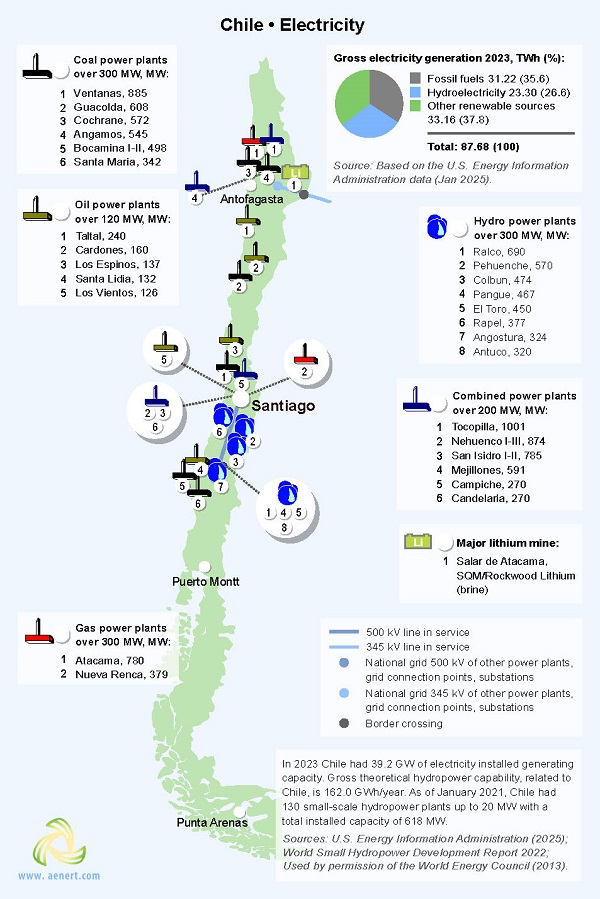
Chile's electricity system has one of the world's highest solar curtailment rates in the norte chico and norte grande regions — driven by the extraordinary solar resource of the Atacama, excess generation relative to demand, and insufficient north-south transmission capacity. Storage is essential to capturing the value of this generation. Ley 21.118 (2019) modified the General Electricity Law to explicitly recognise battery storage as a distinct category and enabled CNE to include storage in its long-term capacity auctions.
PMGD (Pequeños Medios de Generación Distribuida) governs distributed generation assets between 100 kW and 9 MW connected at the distribution level. PMGD assets receive stabilised prices — averaging forward spot prices to reduce revenue volatility — which makes small-scale distributed generation relatively predictable compared to the spot-exposed large-scale market.
Atacama mining microgrids
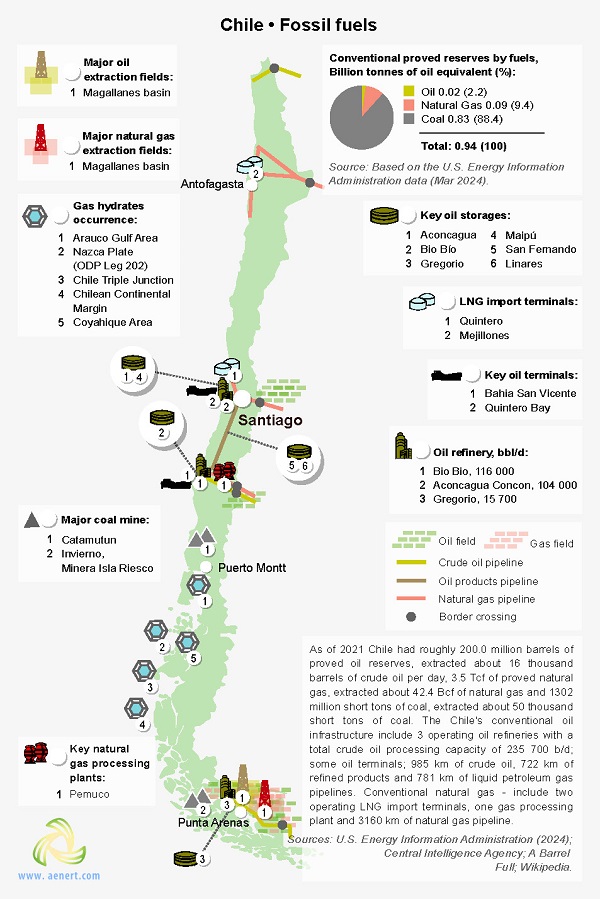
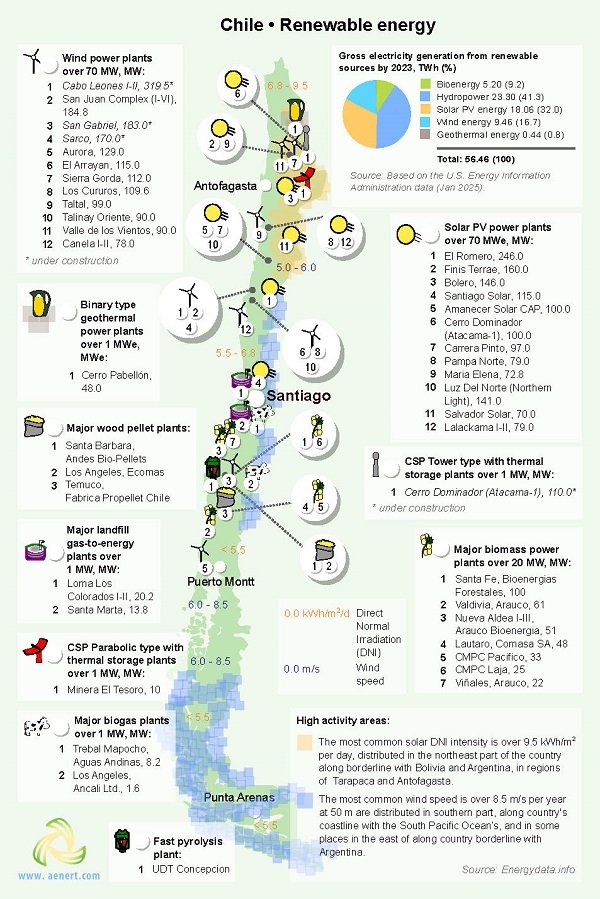
The Atacama Desert hosts the world's highest-altitude, highest-irradiance solar resource and the world's largest deposits of lithium and copper. BHP Escondida — the world's largest copper mine — Codelco's Chuquicamata, Radomiro Tomic, and Gabriela Mistral mines, SQM's lithium brine operations in the Salar de Atacama, and Albemarle's La Negra lithium hydroxide plant collectively represent some of the world's largest off-grid and semi-grid-connected industrial power consumers.
Mining decarbonisation commitments are driving rapid adoption of solar-plus-storage in the Atacama. BHP's climate commitment targets net zero by 2050 and a 30% emissions reduction by 2030 from a 2020 baseline. Codelco's 2030 target covers scope 1 and 2 emissions. Antofagasta Minerals targets carbon neutrality by 2040. For these operations, which run 24/7 at multi-hundred-MW load levels, HOMER Pro provides the technical-economic modelling to size and justify the solar farms, wind turbines, and battery storage systems replacing diesel and grid-imported fossil generation.
Desalination plants — essential in the water-scarce Atacama — add an interesting modelling dimension: large RO desalination loads are somewhat flexible (water can be stored in tanks), enabling demand response that HOMER Pro models as dispatchable loads that help absorb solar surplus during peak generation hours.
Ley 21.118 and grid-scale BESS
Chile's CNE uses Ley 21.118 storage recognition to include BESS in its licitaciones (electricity supply auctions) as a firming resource for renewable generation contracts. The north-south transmission bottleneck — where Atacama solar generation regularly exceeds northbound line capacity — creates a high economic value for local storage that captures curtailed generation for evening delivery. HOMER Front models these storage-plus-solar projects against CNE auction contract structures and spot price arbitrage on the SEN.
The SSAA (Servicios Complementarios) mechanism — Chile's ancillary services framework — procures frequency regulation and reserve services. CEN conducts SSAA tenders, and BESS increasingly clears these tenders for fast frequency response products, stacked with energy arbitrage revenue on the spot market.
PMGD distributed generation
Chile's PMGD framework has created a substantial distributed generation market, particularly in the central and southern regions where distribution-connected solar can sell at stabilised prices. HOMER Grid models PMGD assets against the CNE-published stabilised price index and the economics of on-site consumption versus PMGD export. C&I consumers in Santiago, Valparaíso, and Concepción increasingly combine PMGD solar with behind-the-meter storage under HOMER Grid's dual-mode economic model.
Foundational HOMER references
View full bibliography →HOMER is used for energy projects in Chile and over 190 countries worldwide. Its modelling methodology — developed at the U.S. National Renewable Energy Laboratory (NREL) — is documented in these foundational references. Browse the full bibliography for 1,000+ applied studies.
-
Computer Modeling of Renewable Power Systems
Lilienthal, P.D., Lambert, T.W. & Gilman, P. (2004). Encyclopedia of Energy, NREL Report CH-710-36771.
-
Using HOMER Software, NREL's Micropower Optimization Model, to Explore the Role of Gen-sets in Small Solar Power Systems (Case study: Sri Lanka)
Givler, T. & Lilienthal, P. (2005). NREL/TP-710-36774.
-
Review of software tools for hybrid renewable energy systems
Sinha, S. & Chandel, S.S. (2014). Renewable and Sustainable Energy Reviews, vol. 32.