
HOMER Knowledge Base
Modeling an electrolyzer in HOMER
If you include a minimum load ration of 72% in the generator, the capacity factor of the electrolyser reaches 99% (it means that it was operating most of the time); with 30% it only reaches 60%...
This is a tricky system to model in HOMER. It does not "think ahead" when operating the electrolyzer. HOMER operates the electrolyzer only when there is excess electricity or when necessary to avoid unmet hydrogen load. If there were no excess electricity for the electrolyzer to use, the initial 100 kg of hydrogen in the hydrogen tank would cover the hydrogen load for the first three weeks or so, but then once it was empty and the next hydrogen load spike occurred, HOMER would try running the electrolyzer to produce just enough hydrogen to serve that load. But to supply a 2 kg/hr hydrogen load requires a 260 kW electrolyzer, and your electrolyzer is only 24 kW. So the system simply can't serve the hydrogen load on demand. The electrolyzer needs to operate nearly continuously, storing the hydrogen in the hydrogen tank to meet the spikes in the hydrogen load.
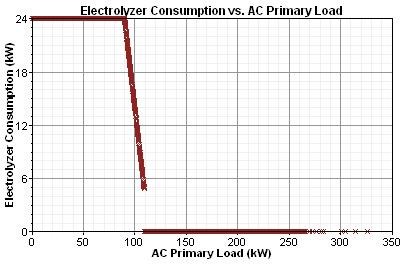
That means the system needs excess electricity, and the only source of electricity in your system is the biogas generator. That generator will produce excess electricity whenever the electric load is less than the generator's minimum load. That's why the generator minimum load ratio is an important variable here. As you increase it, the generator produces excess electricity in more hours of the day so the electrolyzer operates more often. But during the night there is more excess electricity than the electrolyzer can use, and during the day there is no excess electricity because the load exceeds the generator's minimum load.
The scatterplot of electrolyzer consumption versus primary electric load shows how the electrolyzer only gets served when the load is below the minimum diesel output power:
It would certainly be better if HOMER let you schedule the operation of the electrolyzer. For example, if it let you force the electrolyzer to operate all the time. That way, you could get the electrolyzer capacity factor up to 100%. But you would still have a very inefficient system because even with the electrolyzer load added to the primary electric load, the nighttime load is very low so the generator would run at its low load ratio, where it is very inefficient, and it would still be producing excess electricity that the system would have to throw away. A second, much smaller diesel or a battery bank to meet the low nighttime load would lead to a big improvement in efficiency, but the problem of the electrolyzer only operating on excess electricity would not go away.
The good news is that for your system it is quite easy to calculate the required size of the hydrogen tank - it would need to be something like 3 kg to allow the electrolyzer to run continually at a constant rate to fill it. I recommend that you calculate the cost of a hydrogen tank of whatever size you want, enter it in HOMER as a system fixed capital cost, remove the hydrogen tank from the schematic, and flatten out your hydrogen load so that it is the same in every hour (remember to remove the noise). Then HOMER will run the electrolyzer to serve the hydrogen load on demand, but since it is spread out and not happening all at once, your 24 kW electrolyzer should be big enough to do it, and it should run continuously.
Note that you specified the hydrogen load only for weekdays. The load is zero each weekend.