
HOMER Knowledge Base
Modeling organic Rankine cycle unit in HOMER
I am trying to make it work as a standard diesel unit. To show the benefit of the whpp I increased the efficiencies of all the diesels by 10% from changes in the slope and fuel intercept. I am worried this might not be accurate because of how HOMER is programmed to run the diesel optimally.
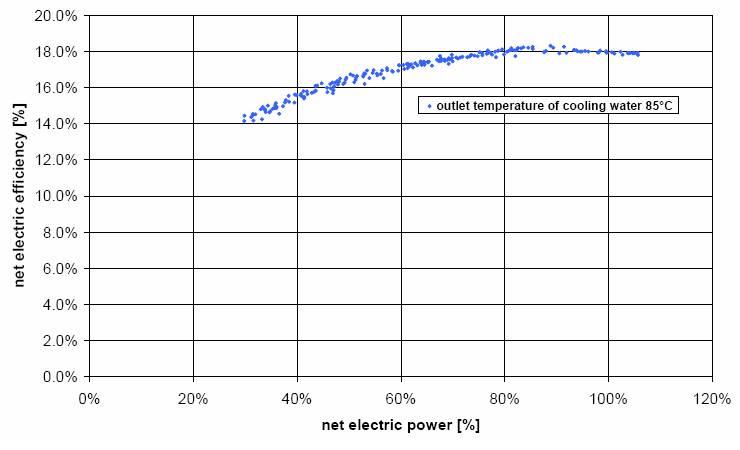
The fuel curve slope and intercept refer only to the electrical efficiency of the unit, so adjust them until the graph of electrical efficiency versus output looks correct. The following graph is all the data I have found on the electrical efficiency of an ORC unit. The heat recovery ratio specifies the thermal output.
Can please give a definition of what the heat recovery ratio is exactly in the diesel settings? Is it based on btu of thermal energy used over the electrical energy produced?
The heat recovery ratio is the proportion of waste heat that can be recovered to serve the thermal load. For more information please look up “heat recovery ratio” in the index of the Help system.
In the engine specs which pull up on the input report-There are engine specifications listed. I am interested in the Average Thermal Output. Is this jacket water system only? Or does this include exhaust heat?
I’m not sure if that’s a HOMER question or not. The heat recovery ratio would be higher if you recovered heat from both the jacket water system and the exhaust system, than if you recovered heat only from one or the other.
How does HOMER calculate thermal loads. I notice when adding a thermal load the overall cost per kWh goes down. Does HOMER calculate the cost of the offset kWh? I might think that it programs the diesels to run at a more efficient rate –thus reducing fuel consumption but the consumption remains the same.
The definition of the levelized cost of energy (cost per kWh) is a little fuzzy in cogeneration systems. We define it as the average cost of electrical energy, so we try to subtract out the cost of serving the thermal load. HOMER does not assume any change in the efficiencies of the generators due to the presence of the thermal load, but when you are making use of the waste heat from a generator you are getting better value out of the fuel you put into it.
I have also modeled a VRB system. My questions have to do with how you modeled it in the program. Does the VRB in the program run the diesels at an optimum efficiency? How does it determine the charge cycle? I did not see the expected cost savings and I think it might be due to how VRB is programmed to operate in HOMER.
HOMER always runs the dispatchable power sources (generators, battery, grid) so as to minimize cost, which in the case of generators is not necessarily the same as maximizing efficiency since fuel cost is only part of the total cost of operating a generator. Under the cycle charging strategy, the generator will charge the battery whenever it runs. Under the load following strategy, only the renewable power sources will charge the battery. For details, please look up “load following” and “cycle charging” in the index of the Help system.