
HOMER Knowledge Base
Synthetic loads
Your comparison between the actual and synthetic load data wasn't quite right for two reasons. First, the scaled annual averages were a little different in the two cases. You want the synthetic data scaled to exactly 15,202 kWh/day to match the actual data as well as possible. Second, HOMER's poorly-designed load inputs window stymied your attempt to enter one annual average daily profile. The profile you entered applied only to January.
I synthesized your original load data twice, once using twelve monthly average profiles and once using one annual average profile. In both cases I used the 6.4% daily noise and 5.4% hourly noise that HOMER calculated from the original data. The following DMaps show that the seasonal pattern persists when synthesizing with the monthly profiles, but not with the annual profile:
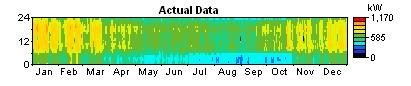
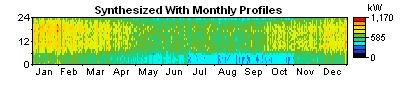
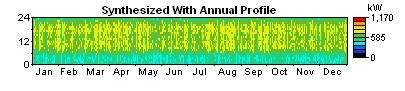
With all your sensitivity cases it's hard to compare results, so I just looked at the total NPC for the winning system in the first sensitivity case. The original data gave an NPC of $4,246,649. The monthy-synthesized data gave an NPC of $4,243,992 which is 0.06% low. The annually-synthesized data gave an NPC of $4,271,945 which is 0.6% high. That's really close, but you probably care about something other than NPC, and the first sensitivity case might not be the best comparison, so take a closer look. The attached zip file contains the three load data sets and the two HOMER files I created. I changed the extension to .notzip to evade NREL's filter.
Now the years-to-positive cash flow issue. Again I'm going to concentrate on the winning system for the first sensitivity case. The grid-connected system costs $3.6 million initially and has an annual operating cost of $50,000/yr. That's a cash flow that will never go positive. If the grid income exceeded the turbine O&M they you would have a chance, but the grid income is only $20,000/yr and the turbine O&M is $70,000/yr, so the hole just keeps getting deeper. Even more so for the off-grid system, which has a capital cost of $5.8 million and an levelized annual operating cost of $475,000/yr. (It actually changes from year to year as components need replacement, but it's equivalent to a steady annual cost of $475,000/yr.) That's not so say the systems are bad ideas, because the alternatives also cost money. You would have to compare, say, the grid-wind turbine system to the grid-only system to determine payback, years to positive cash flow, IRR, etc. Is that what you want to do? (You have disallowed the grid-only system by imposing the 40% minimum renewable fraction.)
One more note. It looks like the wind data you entered were measured at 10m above ground, and you are telling HOMER to scale that up to the 80m hub height using the logarithmic profile. Is that right? If you don't have any measured data from higher than 10m, that's probably the best you can do. But in my experience the daily profile at 80m is very different from that at 10m. If fact, out on the wide-open plains the profile at 50m is often the opposite of that at 10m, as in the following graph:
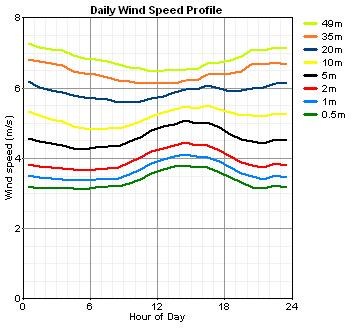
So the afternoon peak at 10m corresponds to an afternoon trough at 50m. This happens because daytime mixing brings the strong upper-level winds down to the surface. On the plains, this is the dominant daytime effect. But your wind regime is probably dominated by the sea breeze, which might change things quite a bit. All I can say is that a lot can happen between 10m and 80m.