HOMER Knowledge Base
The effect of discount rate in HOMER
Here I am asking rather basic questions on economics. I have attached 2 HOMER files. I want to know the effect of increase in the rate of interest on the overall project economics. From these 2 files it can be seen in the sensitivity results window that with the increase in the rate of interest, the COE increases while NPC decreases.
Now, I do not understand why it is so. Is it a general rule that this trend is always like this? If interest rate increases then I will have to repay more, so my cost increases and therefore COE is more. But why NPC will decrease? What is the interpretation of this?
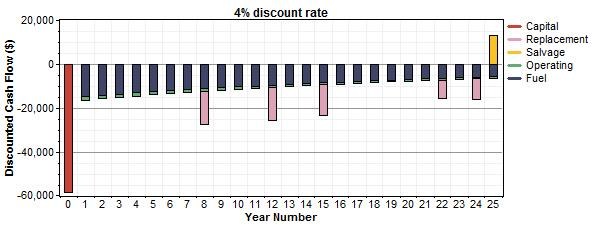
I don’t think you can say that in all instances, NPC will decrease with increasing discount rate. (HOMER calls it the real interest rate, but we will probably change that to discount rate.) But it will with the pattern of cash flows typical to a stand-alone power system: capital cost up front, then continuing costs throughout the project lifetime with little or no revenue. The higher the discount rate, the smaller the discounted value (net present value) of a future cash flow. To demonstrate, here are the discounted cash flows for a diesel system at 4% discount rate:
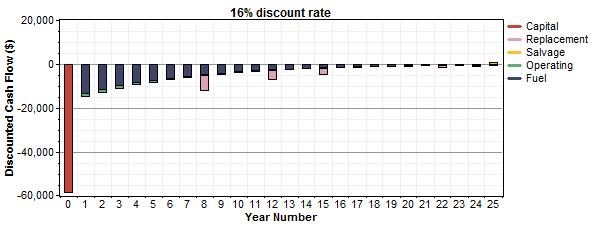
The nominal value of those fuel costs stays constant throughout the 25 years, but their discounted value decreases as you go farther into the future. At a higher discount rate, that discounting effect is stronger. Here is the same set of cash flows at a discount rate of 16%: