
1
Imperfect foresight
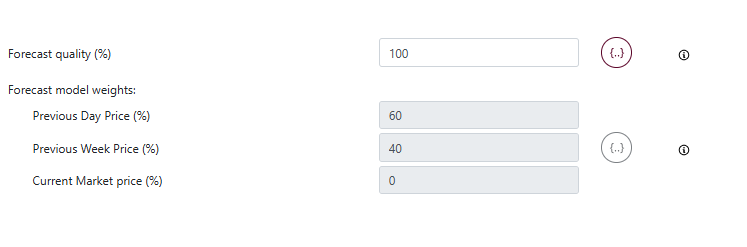
Compose the next 48-hour forecast from Week-1, Day-1 and DAM signals. DAM contribution can be adjusted or disabled, while forecast and realized prices can diverge to represent price uncertainty.

New release
Eight coordinated upgrades for more realistic, flexible market modeling.
A stronger foundation for BESS and hybrid-project decisions.
Feature overview
Eight coordinated capabilities, delivered as one integrated release.
More options to build the expected production depending on the type of market.
Combine obligations and dispatch pathways.
Vary market assumptions by project year.
Steer RT attribution relative to DAM.
Explore accelerated cycling scenarios.
Commit across complete bid windows.
Show DAM inputs only when relevant.
Model condition-dependent auxiliary loads.
1–3 · Market realism and structure
Compose the next 48-hour forecast from Week-1, Day-1 and DAM signals. DAM contribution can be adjusted or disabled, while forecast and realized prices can diverge to represent price uncertainty.
Model multiple dispatch mechanisms and obligations in parallel. Allocate distinct energy shares and prices to each Time-of-Delivery arrangement, and separate dispatch by technology when required.
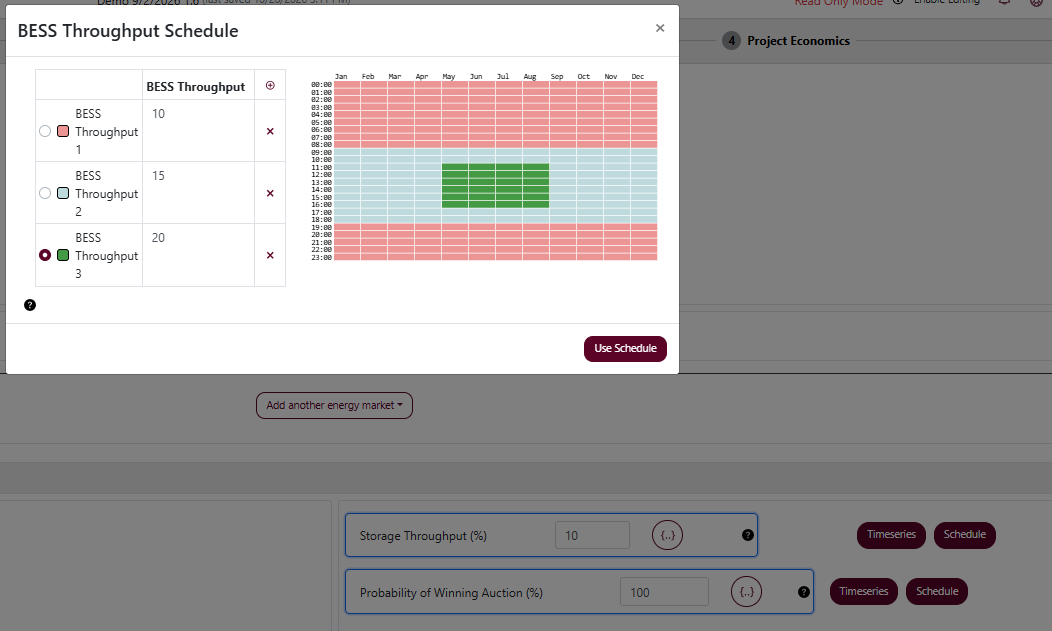
Vary Storage Throughput (Activation), Probability of Winning Auction and BESS capacity availability by project year, replacing one static lifetime assumption.
4–8 · Optimization control
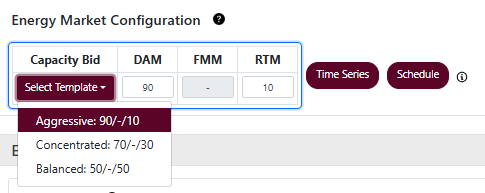
Set Real-Time market volume relative to DAM, guiding realistic energy allocation across markets based on available volume.
Optionally remove the cycling-cost constraint to test more aggressive BESS cycling and an accelerated modeled break-even.
Represent regulation markets such as FCR, where the BESS commits to the complete bid window, typically four hours, rather than participating hour by hour.
Display Day-Ahead Market percentages only when DAM is active, keeping inputs and results clearer.
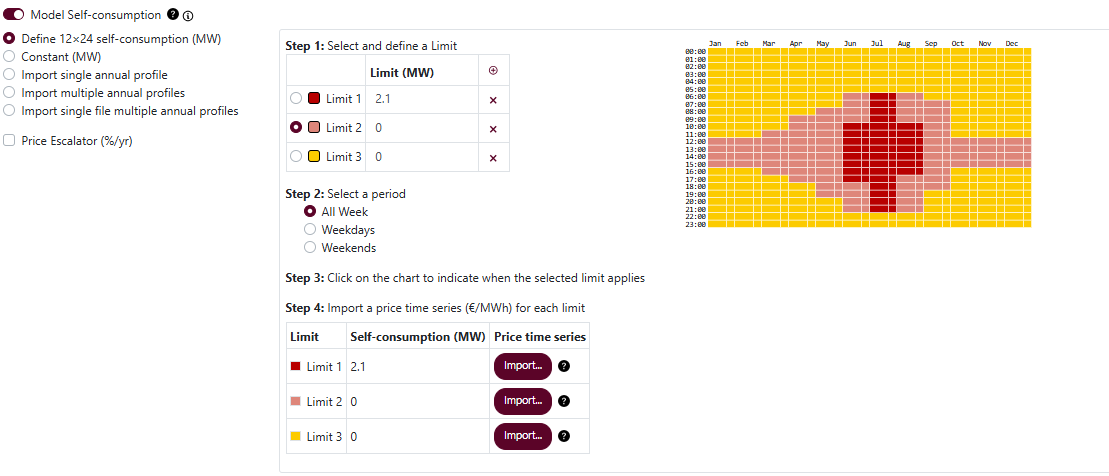
Differentiate auxiliary consumption by temperature and BESS operating state: idling, charging or discharging.
Release foundation
A broad stabilization effort strengthens calculation integrity, market settlement, reporting consistency and product resilience.
Grid sales totals, export-limit behavior, C-rate and capacity values.
TOD allocation and penalties, aFRR Down and Reg Down expense.
UI versus Excel, decimal separators and production versus development alignment.
1.5 stabilization QA, security alerts and incident workflow.
Major defects removed+More consistent results=A stronger production foundation
Ready to explore HOMER Front 1.6?