Africa & Middle East — Egypt
HOMER software for energy projects in Egypt
Egypt hosts Benban — one of the world's largest solar parks — and the Gulf of Suez wind corridor, one of Africa's strongest wind resources. With a large industrial base, a fast-growing electricity demand, and aggressive renewable targets under Egypt Vision 2030, Egypt is the MENA region's most diverse energy modelling market.
Egypt's electricity sector
EETC (Egyptian Electricity Transmission Company) manages Egypt's high-voltage transmission grid and serves as the state offtaker for independent power producers under long-term PPAs. EEA (Egyptian Electric Utility and Consumer Protection Regulatory Agency) is the sector regulator, governing tariffs, licensing, and distribution utility oversight. NREA (New and Renewable Energy Authority), under the Ministry of Electricity and Renewable Energy, develops government-owned renewable projects and manages the Kom Ombo and Benban solar zones, the Zafarana and Gulf of Suez wind corridors, and the country's renewable energy auction programmes.
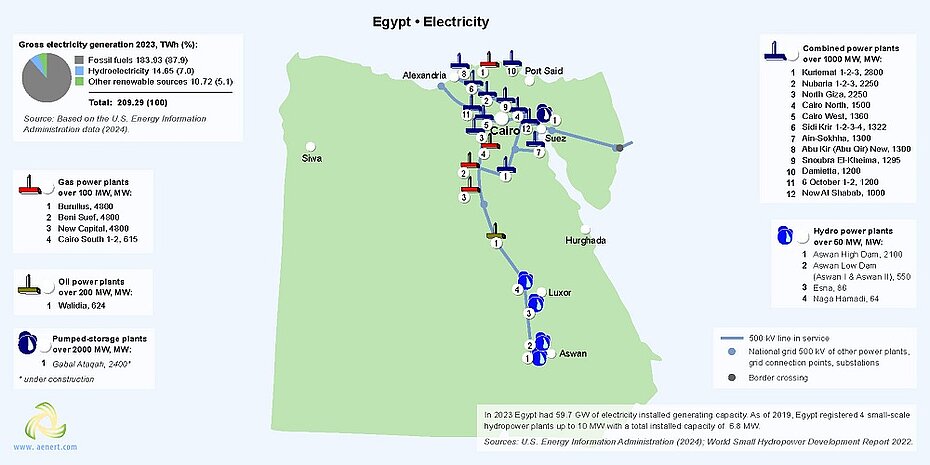
Egypt's Integrated Sustainable Energy Strategy 2035 targets 42% renewable electricity by 2035. Hydropower (the Aswan High Dam and associated plants, approximately 2.8 GW) provides seasonal baseload. Gas-fired combined cycle plants (SIEMENS 14.4 GW Beni Suef, Burullus, and New Capital mega-plants) dominate mid-merit dispatch. The renewable buildout is focused on the Upper Egypt solar belt, the Suez Canal wind corridor, and the emerging floating solar and wind-hybrid potential of Lake Nasser.
Utility-scale solar and wind — HOMER Front
Benban Solar Park in Aswan Governorate is one of the world's largest solar installations: 1.65 GW across 41 sub-plants developed by international IPPs including Scatec, ACWA Power, and multiple others under EETC 25-year PPAs. GHI at Benban exceeds 2,600 kWh/m²/year — among the world's highest. The Zafarana wind farm (545 MW) on the Gulf of Suez coast and the Gabal El Asfar and West Bakr wind projects represent Egypt's established wind sector.
HOMER Front models Egyptian utility-scale project economics: solar generation at Upper Egypt irradiance levels, wind generation at Gulf of Suez capacity factors (often exceeding 40%), EETC PPA dispatch structures, BESS co-location sizing for curtailment risk management as renewables penetration rises, and the optimisation of hybrid solar-wind-storage plants against EETC's grid dispatch requirements. Egypt's FiT (Feed-in Tariff) programme (rounds 1 and 2, 2014–2017) has given way to competitive auction procurement; new rounds are under development by NREA.
Industrial zones and C&I — HOMER Grid
Egypt's large industrial base — cement, steel, aluminium, ceramics, chemicals, and food processing — is concentrated in industrial zones across Greater Cairo (10th of Ramadan City, Borg Al Arab), Suez Canal Economic Zone (SCZone), and Upper Egypt. Egypt's industrial electricity tariffs have been adjusted upward under an IMF-supported subsidy reform programme, significantly improving the economics of behind-the-meter solar generation for energy-intensive industries.
HOMER Grid models Egyptian C&I energy systems: rooftop and ground-mounted solar at industrial zone irradiance levels (Cairo: 5.5 kWh/m²/day, Aswan: 7.0 kWh/m²/day), BESS for demand peak management under EETC maximum demand tariff structures, self-consumption optimisation under EEA's net metering regulations, and the economics of self-generation versus utility supply under reformed industrial tariffs. The Suez Canal Economic Zone's energy infrastructure investments — attracting manufacturing from China and the GCC — create a growing market for industrial microgrid design.
Rural Upper Egypt and remote communities — HOMER Pro
Upper Egypt's Western Desert, South Sinai, and remote communities along the Red Sea coast have historically relied on diesel generators for electricity supply. Egypt's Universal Service Obligation and the Ministry of Electricity's rural electrification programme have extended grid connectivity to most villages, but isolated communities in the Wadi Allaqi area, remote oases (Siwa, Kharga, Dakhla), and desert tourism resorts operate independent power systems.
HOMER Pro models Egyptian off-grid and isolated grid systems: solar generation at the world's highest irradiance conditions, battery sizing for overnight supply in locations with no diesel supply chain, and the economics of solar-battery versus diesel-battery hybrid configurations for Red Sea coast eco-resorts, desert research stations, and remote community electrification. Egypt's tourism infrastructure in South Sinai and the Red Sea Governorate includes a number of HOMER-modelled standalone and mini-grid systems.
Egyptian market context
EETC (Egyptian Electricity Transmission Company)
State transmission grid operator and single buyer for IPP generation under long-term PPAs. Primary counterparty for utility-scale renewable energy project development in Egypt.
NREA (New and Renewable Energy Authority)
Develops and manages government renewable energy projects, administers the FiT programme and auction rounds, and manages the Benban, Kom Ombo, and Gulf of Suez renewable energy zones.
EEA (Egyptian Electric Utility and Consumer Protection Regulatory Agency)
Regulates electricity tariffs, distribution utility licensing, and net metering for self-generation. Governs the regulatory framework for C&I embedded generation and grid export.
SCZone (Suez Canal Economic Zone)
Special economic zone spanning Ain Sokhna, East Port Said, Qantara East, and Ismailia. Offers preferential energy tariffs and industrial infrastructure to attract manufacturing investment, creating a concentrated C&I energy modelling market.
Selected HOMER research in Egypt
View full bibliography →Studies that used HOMER to model hybrid power systems for remote and agricultural applications in Egypt, drawn from the HOMER bibliography of 1,000+ publications.
-
An Optimization Approach to Hybrid Power Systems for Remote Area Applications in Egypt
Kamel, S. (2003). PhD Thesis, Colorado School of Mines.
-
The Economics of Hybrid Power Systems for Sustainable Desert Agriculture in Egypt
Kamel, S. & Dahl, C. (2002). Proceedings of the Sustainable Energy and Development Conference.
Ready to model your Egypt project?
Whether you're developing a utility-scale solar project in the Benban zone, modelling a C&I system for an SCZone industrial facility, or designing an off-grid system for Upper Egypt, HOMER gives you the analysis your lenders and counterparties require.