Africa & Middle East — Kenya
HOMER software for energy projects in Kenya
Kenya generates over 90% of its electricity from renewables — geothermal, hydro, and wind — making it one of Africa's cleanest grids. The energy challenge here is access: extending and deepening electricity availability to the arid north and remote communities, while optimising C&I economics under Kenya Power's time-of-use tariff structures.
Kenya's energy sector
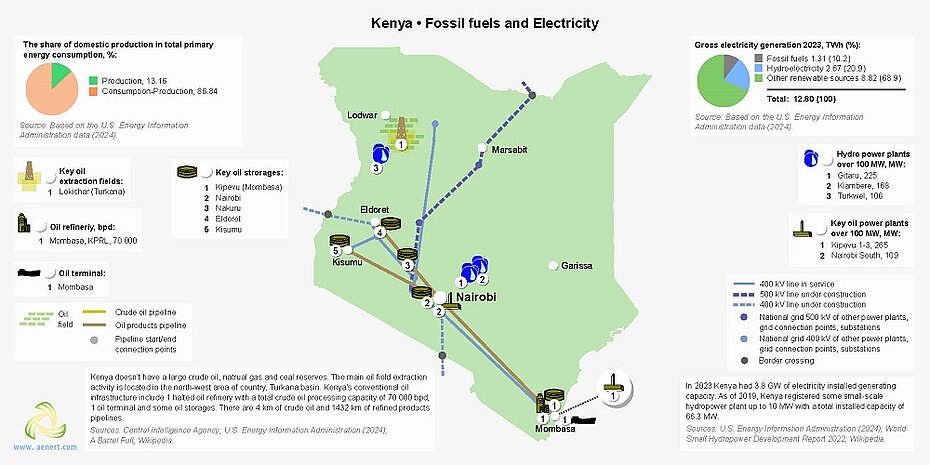
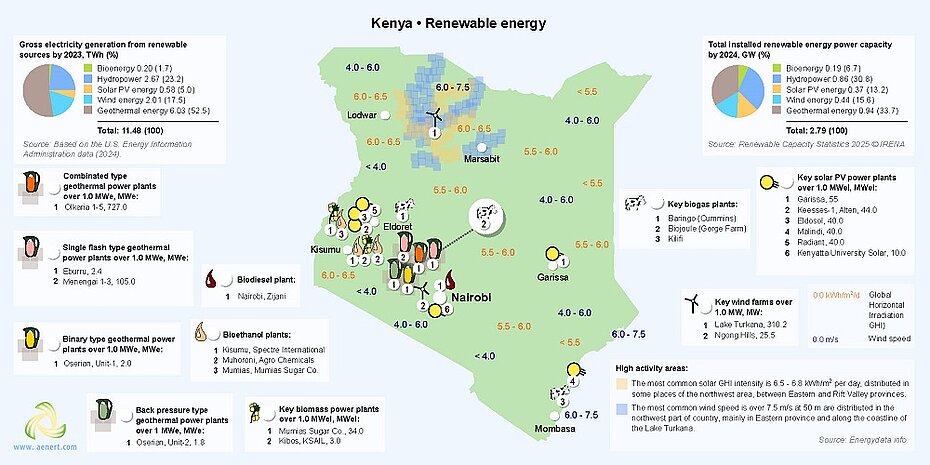
EPRA (Energy and Petroleum Regulatory Authority) regulates Kenya's energy sector. KenGen (Kenya Electricity Generating Company) is the dominant generator, operating geothermal capacity at Olkaria (the world's largest geothermal complex outside the United States), hydro, wind (Lake Turkana, 310 MW), and thermal. Kenya Power (Kenya Power and Lighting Company, KPLC) is the single-buyer utility and grid operator. KETRACO (Kenya Electricity Transmission Company) manages the high-voltage transmission network.
Kenya's national electrification rate has risen from approximately 30% in 2013 to over 75% by 2023, driven by the Last Mile Connectivity Programme (LMCP) and grid densification. The remaining unserved population is concentrated in Arid and Semi-Arid Lands (ASAL) counties — Turkana, Marsabit, Mandera, Wajir, Garissa, and others — where grid extension is uneconomical and off-grid solar, mini-grid, and hybrid systems are the appropriate solution. Kenya's Renewable Energy Feed-in Tariff (REFIT) policy and the mini-grid regulatory framework under EPRA govern the licensing of private generation and mini-grid operations.
C&I solar, BESS, and net metering — HOMER Grid
Kenya Power's commercial and industrial tariffs — SC1 (small commercial), SC2 (medium commercial), and SI (industrial) with maximum demand charges — create a strong economic case for behind-the-meter solar. Time-of-use tariffs introduce peak and off-peak differentiation, making BESS co-location increasingly valuable for demand peak shifting. Kenya's net metering regulations (under EPRA's Net Metering Regulations 2012, subsequently revised) allow C&I solar exporters to net against consumption, though export volumes at commercial scale are limited by grid injection constraints on most distribution feeders.
HOMER Grid models the Kenyan C&I scenario: rooftop solar yield at Nairobi's 5.5 kWh/m²/day irradiance, BESS sizing for demand peak reduction under the SI maximum demand charge, self-consumption optimisation given EPRA's net metering limits, and diesel backup for critical loads during Kenya Power outages. Flower farms, tea factories, telecommunications base stations, and Nairobi commercial real estate are established HOMER users in Kenya. East African Breweries, Bamburi Cement, and Safaricom have active renewable energy procurement and self-generation programmes.
Off-grid and rural mini-grids — HOMER Pro
Kenya's ASAL counties host some of East Africa's most challenging electrification environments — remote communities with low load density, high solar irradiance (6+ kWh/m²/day in northern Kenya), and logistically difficult diesel supply. The Last Mile Connectivity Programme has extended the grid to many communities, but northern Turkana, Marsabit, and the border counties remain largely unserved. EPRA's Mini-Grid Regulations establish a clear licensing framework: Isolated Mini-Grid (IMG) licences allow private operators to develop, own, and operate solar-battery or solar-diesel-battery systems under cost-reflective tariffs regulated by EPRA.
HOMER Pro models Kenyan rural mini-grids: solar generation profiles using ASAL irradiance data, battery sizing for overnight supply, productive use loads (flour milling, water pumping, refrigeration), and the economic case for diesel hybrid backup during extended cloudy periods. Donor-funded programmes — the World Bank's Kenya Off-Grid Solar Access Project (KOSAP), USAID Kenya, UK FCDO, and the GIZ-supported REEEP framework — require HOMER-based feasibility models for grant applications and financial close documentation.
Utility-scale and geothermal hybrid systems — HOMER Front
Kenya's geothermal-dominated grid creates a distinctive context for renewable integration: geothermal provides stable baseload, while hydro provides flexible generation that fluctuates with seasonal rainfall. Wind at Lake Turkana (310 MW, commissioning 2019) has created curtailment challenges during off-peak periods on the transmission-constrained northern corridor. BESS co-location at Lake Turkana and planned Kipeto and Meru wind projects is under evaluation by KenGen.
HOMER Front models Kenyan utility-scale renewable assets: wind generation profiles using Lake Turkana and highland data, BESS co-optimisation for curtailment reduction and ancillary service provision, and the dispatch economics of geothermal-wind-hydro hybrid systems on the KenGen dispatch merit order. Kenya's REFIT framework sets feed-in tariffs for eligible renewable technology categories; Kenya Power's competitive procurement (competitive bidding for renewable projects) is creating IPP opportunities that HOMER Front can model for pre-bid feasibility.
Kenyan market context
EPRA (Energy and Petroleum Regulatory Authority)
Regulates electricity generation, transmission, distribution, and supply. Issues mini-grid licences, approves REFIT tariffs, and governs net metering for small-scale embedded generation.
KenGen (Kenya Electricity Generating Company)
State-owned dominant generator, operating the Olkaria geothermal complex, hydro stations, and the Lake Turkana wind farm. The primary counterparty for IPP dispatch and grid integration negotiations.
Kenya Power (KPLC)
Single-buyer utility and grid operator. Operates the distribution network and sets retail tariffs under EPRA regulation. Administers net metering connections and REFIT feed-in tariff payments.
KOSAP (Kenya Off-Grid Solar Access Project)
World Bank-funded programme extending electricity access in ASAL counties. Funds mini-grids, standalone solar, and productive use equipment through results-based financing and private sector matching grants.
Foundational HOMER references
View full bibliography →HOMER is used for energy projects in Kenya and over 190 countries worldwide. Its modelling methodology — developed at the U.S. National Renewable Energy Laboratory (NREL) — is documented in these foundational references. Browse the full bibliography for 1,000+ applied studies.
-
Computer Modeling of Renewable Power Systems
Lilienthal, P.D., Lambert, T.W. & Gilman, P. (2004). Encyclopedia of Energy, NREL Report CH-710-36771.
-
Using HOMER Software, NREL's Micropower Optimization Model, to Explore the Role of Gen-sets in Small Solar Power Systems (Case study: Sri Lanka)
Givler, T. & Lilienthal, P. (2005). NREL/TP-710-36774.
-
Review of software tools for hybrid renewable energy systems
Sinha, S. & Chandel, S.S. (2014). Renewable and Sustainable Energy Reviews, vol. 32.
Ready to model your Kenya project?
Whether you're designing a C&I solar system under Kenya Power's tariff structure, developing a KOSAP-funded ASAL mini-grid, or modelling a utility-scale wind-BESS asset, HOMER gives you the rigorous analysis your funders require.