Africa & Middle East — Nigeria
HOMER software for energy projects in Nigeria
Nigeria has Africa's largest economy, highest population, and one of its most unreliable electricity grids. Less than 50% of grid capacity is typically available at any time. The result is Africa's largest market for diesel self-generation — and its largest potential market for solar-battery displacement of that diesel. HOMER models both.
Nigeria's electricity market
The Nigerian Electricity Supply Industry (NESI) was unbundled under the Electric Power Sector Reform Act (EPSRA) 2005. Generation is provided by successor GenCos (thermal) and government-owned hydro stations (TCN, Shiroro, Kainji, Jebba), purchased in bulk by NBET (Nigerian Bulk Electricity Trading Plc), and distributed by 11 privatised DisCos (Distribution Companies). NERC (Nigerian Electricity Regulatory Commission) is the sector regulator. Despite reform, aggregate technical, commercial, and collection (ATC&C) losses across the DisCos exceed 40%, and total available grid capacity is typically 3,000–5,000 MW against an estimated demand of 20,000+ MW.
The MYTO (Multi-Year Tariff Order) governs DisCo retail tariffs, with a cost-reflective tariff only partially implemented. The shortfall between cost-reflective and actual tariffs creates DisCo cash flow deficits that cascade into non-payment to NBET and GenCos, depressing available generation. The practical consequence for C&I consumers is that reliable electricity requires self-generation — currently satisfied by an estimated 14,000 MW of diesel generating sets across the country.
C&I diesel displacement — HOMER Grid
Nigeria's industrial and commercial electricity costs are among the world's highest in effective terms: businesses run diesel generators at NGN 300–600/litre (USD 0.20–0.40/litre) for significant portions of operating hours. A typical Lagos or Abuja commercial facility running diesel 12 hours per day faces electricity costs of USD 0.40–0.80/kWh. Solar-battery hybrid systems that displace daytime diesel generation and provide backup during grid outages achieve paybacks of 3–5 years at these fuel prices.
HOMER Grid models the Nigerian C&I scenario: variable grid availability (typically 4–12 hours per day depending on DisCo and feeder), diesel generator backup for critical loads, and solar-battery sized to maximise diesel displacement within the grid availability window. NERC's mini-grid regulations and the Nigerian Electricity Management Services Agency (NEMSA) equipment approval requirements apply to behind-the-meter installations at commercial scale. Banking, telecommunications, cold chain logistics, and manufacturing in the Lagos-Ibadan corridor, the Kano/Kaduna industrial belt, and Port Harcourt's oil services sector are the primary C&I market segments.
Rural mini-grids — HOMER Pro
Nigeria has approximately 80 million people without electricity access, the largest energy access deficit in the world. The majority are in rural communities across the North West, North East, North Central, and parts of the South South zones, where grid extension is either uneconomical or structurally obstructed. Nigeria's Rural Electrification Agency (REA), through the Rural Electrification Fund (REF) and the Energising Economies Initiative, has created Results-Based Financing (RBF) and development finance programmes that support solar-battery mini-grids in unserved communities.
HOMER Pro is the standard feasibility tool for Nigerian mini-grid project development. NERC's Mini-Grid Regulations (2016, revised 2021) establish the commercial framework: Isolated Mini-Grid (IMG), Grid-Interconnected Mini-Grid (GIMG), and Captive Power regulations govern licensing, tariff-setting, and the treatment of existing mini-grids when the national grid eventually arrives. Established developers including Husk Power Systems, ENGIE Energy Access, PowerGen Renewable Energy, and Daystar Power use HOMER Pro to generate the feasibility studies required for REA grant applications and DFI project finance.
Utility-scale renewables — HOMER Front
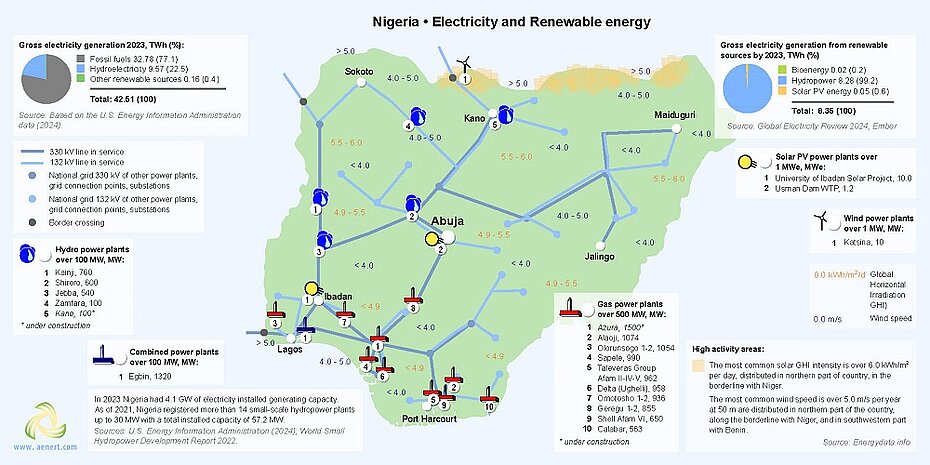
Nigeria's utility-scale renewable pipeline is growing, driven by the Federal Government's Integrated Energy Policy, the Renewable Energy Master Plan, and NBET's Eligible Customer framework. Solar irradiance across northern Nigeria exceeds 6 kWh/m²/day, among the world's highest for any populous country. The Jigawa Solar project (100 MW), Katsina wind farm (10 MW), and Trans-Saharan solar interconnection concepts represent the upstream end of Nigeria's renewable infrastructure development.
HOMER Front models Nigerian utility-scale solar-plus-storage assets against NBET PPA structures, grid injection constraints on TCN's transmission network, and the economics of BESS co-location to manage curtailment risk. The Eligible Customer Decree allows large industrial consumers to source power directly from licensed generators — creating bilateral PPA opportunities that HOMER Front can model alongside self-generation scenarios for vertically integrated industrial groups.
Nigerian market context
NERC (Nigerian Electricity Regulatory Commission)
Sector regulator for electricity generation, transmission, distribution, and supply. Issues mini-grid licences and approves DisCo tariff adjustments under the MYTO framework.
REA (Rural Electrification Agency)
Administers the Rural Electrification Fund and Results-Based Financing programmes for mini-grid and standalone solar development. Primary grant funder for rural electrification projects under the PSRP (Power Sector Recovery Programme).
NBET (Nigerian Bulk Electricity Trading Plc)
Single buyer for bulk electricity from GenCos. Issues PPAs for utility-scale generation under the Transitional Electricity Market. The Eligible Customer framework allows direct bilateral power sales to large consumers.
MYTO (Multi-Year Tariff Order)
NERC's tariff framework for DisCo retail electricity pricing. Structured by customer category (residential R1–R4, commercial C1–C2, industrial D1–D3) with time-of-use and maximum demand provisions for large consumers.
Selected HOMER research in Nigeria
View full bibliography →A study that used HOMER to model a hybrid PV/diesel/grid system in Nigeria, drawn from the HOMER bibliography of 1,000+ publications.
-
Comparative Analysis and Simulation of a Hybrid PV/Diesel Generator/Grid System for the Faculty of Engineering Main Building, Rivers State University, Port Harcourt Nigeria
Sigalo, M., Tee, N. & Usman, R. (2017). IOSR Journal of Engineering, vol. 7(9).
Ready to model your Nigerian project?
Whether you're sizing a C&I solar-battery system to displace diesel in Lagos, modelling a rural mini-grid for REA grant application, or developing a utility-scale PPA project, HOMER gives you the analysis your investors and lenders require.