Africa & Middle East — Saudi Arabia
HOMER software for energy projects in Saudi Arabia
Saudi Arabia's Vision 2030 energy transition programme is one of the world's most ambitious: 50% renewable electricity by 2030, 130 GW of new renewables, and NEOM as the template for a zero-carbon city powered entirely by green hydrogen. REPDO's competitive auction programme, ACWA Power's global project development, and Aramco's industrial decarbonisation create three distinct HOMER use cases.
Saudi Arabia's energy sector
Saudi Arabia's electricity sector is dominated by SEC (Saudi Electricity Company), the state utility responsible for generation, transmission, and distribution. GCAM (General Commission for Utilities, formerly ECRA) is the sector regulator. REPDO (Renewable Energy Project Development Office), under the Ministry of Energy, administers the National Renewable Energy Programme (NREP) — the competitive auction programme that has already contracted projects including Sudair (1.5 GW), Neom Green Hydrogen, Al Shuaiba I and II, and numerous other projects totalling over 20 GW in development.
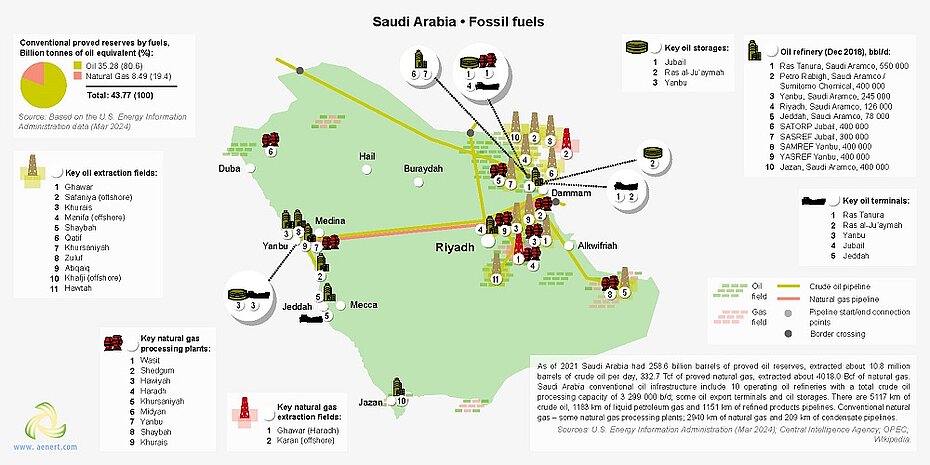
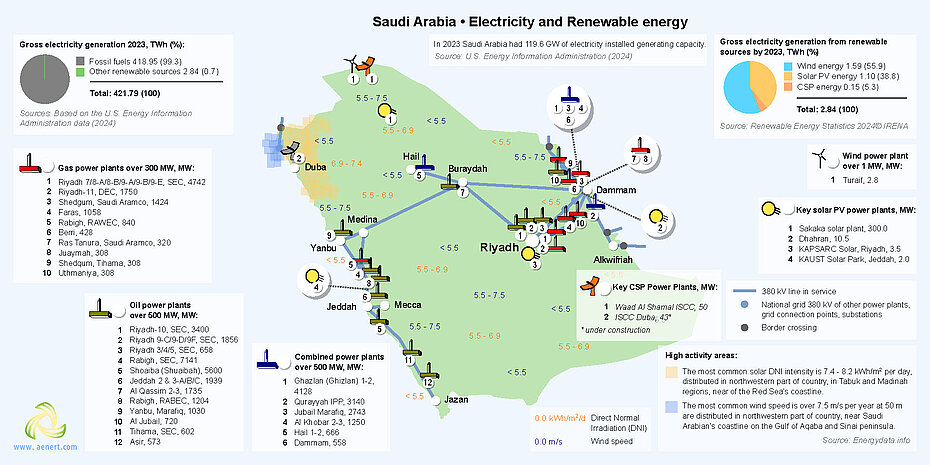
Saudi Arabia generates approximately 60% of its electricity from natural gas and 40% from oil-fired generation — a pattern that Vision 2030's energy transition is seeking to reverse. Domestic energy consumption substitution (reducing oil and gas burned in power generation, freeing it for export) is an explicit driver of the renewables programme. The Kingdom's solar irradiance (GHI 2,000–2,400 kWh/m²/year in the Central Province and Rub al Khali) and wind resource (northwest corridor) make it a globally competitive location for renewable energy.
REPDO utility-scale solar and wind — HOMER Front
The NREP auction programme has produced a series of record-low solar tariffs. Sudair (1.5 GW, ACWA Power / PIF) was awarded at $0.0104/kWh in 2021. REPDO's ongoing programme includes Al Shuaiba I (2.6 GW), Al Henakiyah wind (500 MW), and multi-gigawatt projects across the Central, Western, and Northern regions. BESS co-location requirements are increasing in later rounds, as Saudi Arabia's grid requires storage to firm variable renewable generation against the evening air-conditioning demand peak.
HOMER Front models REPDO project economics: solar and wind generation profiles at Saudi irradiance and wind conditions, BESS dispatch optimisation against SEC's capacity market and ancillary service requirements, curtailment risk modelling as renewable penetration grows toward the 50% target, and the economics of BESS co-location for NREP auction competitiveness. Independent engineers for REPDO project financings use HOMER Front to validate developer P50/P90 generation assumptions and optimise dispatch strategies for lender bankability.
NEOM and green hydrogen — HOMER Front
The NEOM Green Hydrogen project — developed by ACWA Power, Air Products, and NEOM — is the world's largest announced green hydrogen facility: 4 GW of electrolysis powered by 12 GW of wind and solar in northwest Saudi Arabia's NEOM region, targeting 600 tonnes/day of green ammonia for export. The electrolyser-renewable-storage dispatch optimisation that HOMER Front provides is directly applicable at this scale: how to maximise electrolyser utilisation, manage curtailment, size hydrogen buffer storage, and optimise the ratio of renewable capacity to electrolysis capacity.
Beyond NEOM, Saudi Arabia's Vision 2030 hydrogen strategy includes SABIC and Aramco green hydrogen production for industrial feedstock displacement, and export-oriented projects through the King Abdullah Port on the Red Sea. HOMER Front models the electrolyser dispatch economics for projects at all scales: the optimal renewable oversizing ratio for maximum electrolyser utilisation, BESS sizing for renewable firming, and the cost of delivered green hydrogen as a function of electrolyser capex and renewable generation cost assumptions.
Industrial C&I and Aramco decarbonisation — HOMER Grid
Saudi Aramco, SABIC (Saudi Basic Industries Corporation), MAADEN (Saudi Arabian Mining Company), and SABIC's downstream petrochemical operations consume enormous quantities of electricity for oil and gas processing, petrochemicals, aluminium smelting, and phosphate mining. Vision 2030's industrial decarbonisation roadmap, aligned with Saudi Arabia's net zero by 2060 commitment, requires significant electrification and renewable energy integration across these industrial sectors.
HOMER Grid models Saudi industrial C&I energy scenarios: rooftop and ground-mounted solar at industrial complex locations, BESS for demand peak management under SEC's industrial tariff (TOU and maximum demand structures), the economics of self-generation versus SEC supply, and electrification of process heat where technically feasible. NEOM's The Line and Sindalah island projects present extreme off-grid and isolated grid design challenges — zero-carbon urban infrastructure at scale — where HOMER Pro's microgrid dispatch modelling is applicable.
Saudi Arabian market context
REPDO (Renewable Energy Project Development Office)
Ministry of Energy body administering the National Renewable Energy Programme (NREP) competitive auction programme. Issues Request for Proposals, evaluates bids, and awards 20–25 year PPAs with SEC as offtaker.
SEC (Saudi Electricity Company)
State utility and PPA offtaker for NREP projects. Manages the national grid, transmission network, and retail electricity supply under GCAM regulation. Moving toward unbundling under Vision 2030 energy sector reform.
PIF (Public Investment Fund)
Saudi Arabia's sovereign wealth fund and co-developer of major renewable projects including NEOM, Sudair, and several NREP projects. PIF's clean energy portfolio includes ACWA Power (majority ownership) and direct project stakes.
Vision 2030 Energy Targets
50% renewable electricity by 2030 (from ~0.4% in 2020). Net zero by 2060. 130 GW of new renewable capacity. Green hydrogen export programme targeting global market share.
Selected HOMER research in Saudi Arabia
View full bibliography →Peer-reviewed studies that used HOMER to model hybrid power systems for remote electrification and desert environments in Saudi Arabia, drawn from the HOMER bibliography of 1,000+ publications.
-
Techno-economic Evaluation of Off-grid Hybrid Photovoltaic-diesel-battery Power Systems for Rural Electrification in Saudi Arabia
Shaahid, S.M. & El-Amin, I. (2009). Renewable and Sustainable Energy Reviews, vol. 13(3).
-
Technical and Economic Assessment of Grid-independent Hybrid Photovoltaic-diesel-battery Power Systems for Commercial Loads in Desert Environments
Shaahid, S.M. (2007). Renewable and Sustainable Energy Reviews, vol. 11(8).
-
Potential of Autonomous/Off-grid Hybrid Wind-Diesel Power System for Electrification of a Remote Settlement in Saudi Arabia
Shaahid, S.M. et al. (2004). Wind Engineering, vol. 28(5).
-
Techno-economic Potential of Retrofitting Diesel Power Systems with Hybrid Wind-photovoltaic-diesel Systems for Off-grid Electrification of Remote Villages of Saudi Arabia
Shaahid, S.M. et al. (2010). International Journal of Green Energy, vol. 7(6).
Ready to model your Saudi Arabia project?
Whether you're bidding into a REPDO auction, modelling an electrolyser dispatch strategy for the NEOM hydrogen programme, or optimising an Aramco industrial C&I system, HOMER gives you the bankable analysis your financiers require.