Latin America — Colombia
HOMER software for energy projects in Colombia
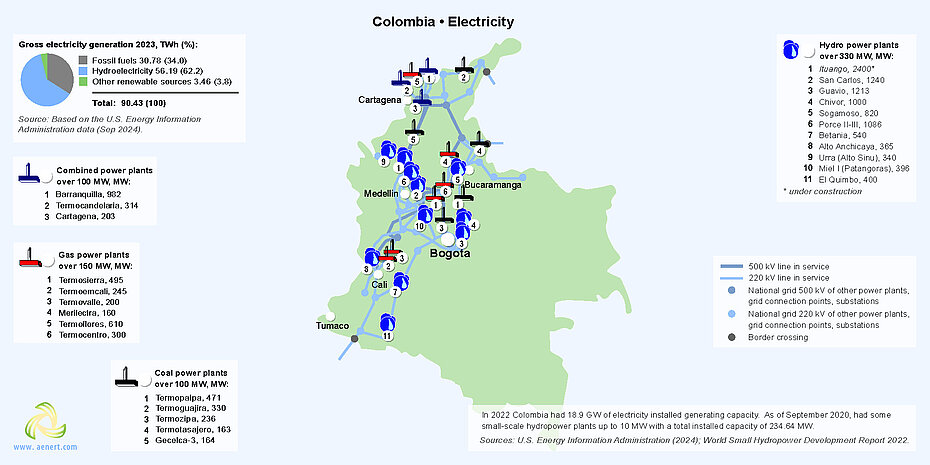
Colombia generates approximately 70% of its electricity from hydropower — a clean but climate-vulnerable resource. El Niño droughts force thermal dispatch at high cost and have spurred Colombia’s FNCER auction programme for non-conventional renewables. Solar and wind development in La Guajira, the Caribe coast, and the Llanos Orientales is now reshaping a grid that until recently had almost no variable renewable generation.
Colombia’s electricity market
Colombia’s electricity market (Mercado de Energía Mayorista, MEM) is regulated by CREG (Comisión de Regulación de Energía y Gas) and operated by XM (Expertos en Mercados). The market is liberalised at the wholesale level, with generators competing in a spot market and a capacity charge (Cargo por Confiabilidad) that remunerates firm capacity obligations — awarded through auctions that incentivise dispatchable and storage assets. Distribution utilities (CODENSA, EPM, CELSIA, and others) serve regulated customers; large unregulated consumers (above 55 kW) can access the free market.
Ley 1715/2014 established the legal framework for non-conventional renewable energy sources (FNCER) and self-generation. Subsequent CREG resolutions and the Decreto 829/2020 created the technical and economic framework for utility-scale FNCER projects and behind-the-meter self-generation. The UPME (Unidad de Planeación Minero Energética) administers FNCER capacity auctions, which have contracted over 2 GW of solar and wind capacity since 2019.
FNCER auctions and utility-scale renewables — HOMER Front
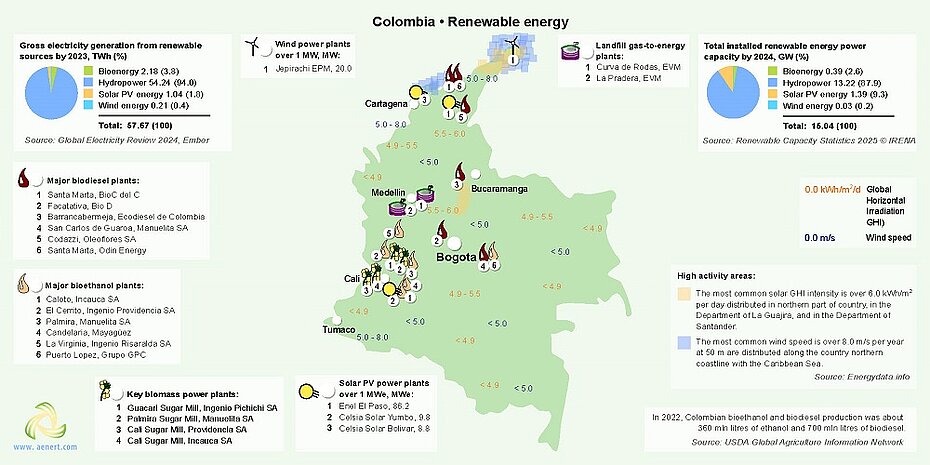
Colombia’s FNCER auction rounds (2019–present) have contracted solar capacity primarily in the Caribbean region — La Guajira, Córdoba, Bolívar, and Cesar — where GHI exceeds 5.5 kWh/m²/day and wind resource at La Guajira (annual average above 9 m/s at hub height) is exceptional. The first commercial wind farms — Windpeshi (204 MW, Enel Green Power) and others in the pipeline — are integrating into a grid that has not previously managed variable renewable curtailment at scale.
HOMER Front models Colombian utility-scale project economics: solar and wind generation profiles under Colombian irradiance and wind conditions, BESS co-location sizing for non-firm contract obligations under CREG dispatch rules, curtailment risk modelling against XM’s dispatch merit order, and the capacity charge (Cargo por Confiabilidad) revenue stack for assets with Obligation de Energía Firme (OEF) commitments. Independent engineers and lenders for FNCER project finance use HOMER Front to validate developer assumptions and stress-test dispatch revenue.
Mining and industrial C&I — HOMER Pro and Grid
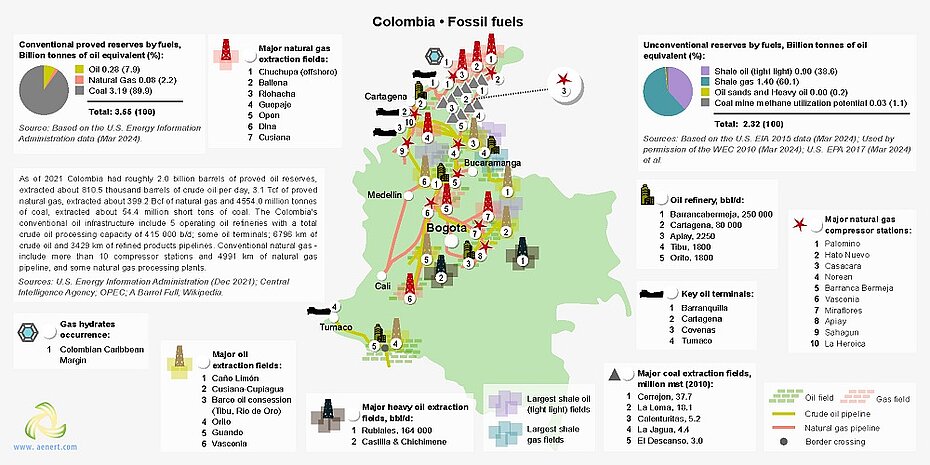
Colombia is the world’s fourth-largest coal exporter. Cerrejón (Glencore, BHP, Anglo American) and Drummond’s mines in La Guajira and Cesar are massive industrial electricity consumers operating in an area with one of Latin America’s best solar and wind resources. Gold and copper mining in Antioquia (AngloGold Ashanti’s Gramalote project, Continental Gold’s Buenavista) and the Cordillera Central creates demand for off-grid hybrid power in high-altitude locations.
HOMER Pro models Colombian mine-site microgrids: diesel hybrid systems in off-grid Andean operations, solar-wind-BESS displacement economics at La Guajira’s exceptional resource conditions, and the integration of mine-site generation into the regional grid under CREG’s self-generation and net metering rules. HOMER Grid models large C&I industrial facilities in free-market access under CREG’s no-regulated consumer framework, optimising the combination of self-generation, BESS demand management, and bilateral renewable PPA procurement.
Distributed generation and self-consumption — HOMER Grid
Ley 1715 and its implementing regulations (CREG Resolución 030/2018, Decreto 829/2020) created a framework for autogeneradores (self-generators) and pequeños autogeneradores below 1 MW to connect to the distribution grid and sell surplus energy under a simplified net metering regime. HOMER Grid models Colombian residential, commercial, and small industrial distributed generation systems against CODENSA, EPM, and other distribution utility tariff structures.
Colombia’s electricity tariff burden on households and small businesses has increased as hydro drought events trigger escalating thermal generation costs. The combination of high retail tariffs, excellent Caribbean solar resource, and the Ley 1715 self-generation incentives (income tax deductions, VAT exemption, accelerated depreciation) makes behind-the-meter solar increasingly attractive. HOMER Grid quantifies the self-consumption economics and optimal BESS sizing for Colombian C&I consumers.
Colombian market context
CREG (Comisión de Regulación de Energía y Gas)
Energy and gas market regulator. Issues resolutions governing generator licensing, distribution tariffs, self-generation rules, net metering, and the MEM market structure. CREG resolutions are the primary technical reference for HOMER input parameters in Colombia.
XM (Expertos en Mercados)
Administers Colombia’s Mercado de Energía Mayorista and dispatches the SIN (Sistema Interconectado Nacional). Publishes hourly spot price (precio de bolsa) and capacity charge data that feeds HOMER Front dispatch modelling.
UPME (Unidad de Planeación Minero Energética)
National energy planning body. Administers FNCER capacity auctions and publishes grid expansion plans. Sets renewable energy targets and manages the transmission planning framework that governs new project interconnection.
Ley 1715/2014
Colombia’s renewable energy and self-generation framework law. Establishes fiscal incentives (income tax deduction, VAT exclusion, import duty exemption, accelerated depreciation) for FNCER and self-generation investments. Extended and strengthened by Ley 2099/2021.
Selected HOMER research in Colombia
View full bibliography →A thesis that used HOMER to model hybrid renewable energy systems in Colombia, drawn from the HOMER bibliography of 1,000+ publications.
-
Hybrid Renewable Energy System Based on Intelligent Optimization Techniques
Donado Mercado, K. (2017). Master's Thesis, Universidad del Norte.
Ready to model your Colombia project?
Whether you’re developing a FNCER auction project in La Guajira, modelling a mining hybrid system in Antioquia, or optimising a C&I self-generation installation, HOMER gives you the techno-economic analysis your investors and lenders require.