Latin America — Mexico
HOMER software for energy projects in Mexico
Mexico has the largest economy in Latin America north of Brazil, one of the region’s strongest solar resources, and an industrial base — automotive, aerospace, electronics, food processing — that makes it one of the world’s most active C&I energy markets. The post-reform regulatory environment and high CFE tariffs for large consumers have created compelling economics for self-generation.
Mexico’s electricity sector
Mexico’s electricity sector was reformed by the Ley de la Industria Eléctrica (LIE) in 2014, which opened the wholesale electricity market (Mercado Eléctrico Mayorista, MEM) and separated CENACE (Centro Nacional de Control de Energía) as the independent grid operator from CFE (Comisión Federal de Electricidad). CRE (Comisión Reguladora de Energía) is the sector regulator, issuing generation permits and governing self-supply scheme operations. SENER (Secretaría de Energía) sets energy policy.
Since 2019, the regulatory environment has shifted: government-owned CFE was repositioned as the priority generator, the capacity auctions that had contracted 8+ GW of cheap solar and wind were cancelled, and new CRE permits for IPPs have been constrained. The practical consequence is that Mexico’s C&I self-supply market — which allows large industrial consumers to self-generate under SEGASE (self-supply) or autogeneration schemes — has become the primary commercial pathway for new renewable energy development. Legacy Energy Reform projects (Energía Limpia certificates, CELs) continue to trade.
C&I self-supply and behind-the-meter — HOMER Grid
Mexico’s largest industrial consumers — automotive plants in Nuevo León, Coahuila, Guanajuato, and Puebla; electronics and aerospace manufacturing in Baja California and Chihuahua; food and beverage producers in Jalisco and Veracruz — face CFE GDMTH (Gran Demanda en Media Tensión Horaria) and GDBT tariffs that include substantial demand charges and energy charges varying by season and time of use. HOMER Grid models the Mexican C&I scenario: rooftop and carport solar against CFE GDMTH time-of-use energy charges, BESS sizing for demand peak reduction, and the economics of self-supply scheme participation versus pure behind-the-meter operation.
The autogeneración and autoabastecimiento schemes (self-generation and self-supply) under CRE permits allow consumers to install generation capacity and credit it against their CFE consumption at multiple metering points. HOMER Grid models these multi-site self-generation structures: the optimal allocation of generation capacity across industrial campuses, the value of BESS for demand charge reduction at individual metering points, and the economics of on-site generation versus signing a virtual PPA with an IPP for CEL credit delivery.
Utility-scale solar, wind, and storage — HOMER Front
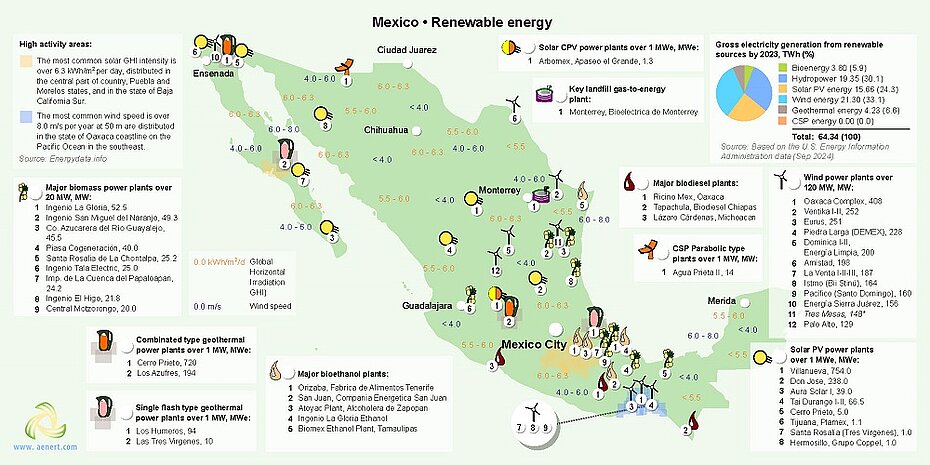
Mexico’s energy auction rounds (2016–2018) produced some of Latin America’s lowest renewable tariffs: solar projects in Sonora at $0.019/kWh, wind in Oaxaca below $0.035/kWh. The Istmo de Tehuantepec wind corridor (Class 1 wind resource, annual average exceeding 10 m/s) and the Sonoran Desert solar belt (GHI exceeding 2,300 kWh/m²/year) remain among the world’s best sites for their respective technologies. Although the national auction programme was cancelled in 2019, new utility-scale projects continue through CRE independent generation permits and self-supply scheme structures.
HOMER Front models Mexican utility-scale project economics: CENACE spot price (precio marginal local, PML) dispatch for merchant generators, CEL (Certificado de Energía Limpia) revenue stacking, and BESS co-location sizing for curtailment management on congested transmission zones in Oaxaca and the Baja California peninsula. Grid connection constraints — particularly the Oaxaca transmission corridor and the Baja California isolated system — require specific curtailment modelling that HOMER Front’s dispatch framework addresses.
Off-grid and remote systems — HOMER Pro
Mexico’s Baja California Peninsula is physically isolated from the national SIN grid; the Baja California Sur system operates as an island grid powered by diesel and LNG with limited solar integration. Remote indigenous communities in Oaxaca, Chiapas, Guerrero, and the Sierra Madre ranges have historically been served by small diesel generators or remain unelectrified. CFE’s electrification programme, supported by CONUEE (Comisión Nacional para el Uso Eficiente de la Energía) and bilateral donor programmes, targets solar-battery off-grid systems for the most remote communities.
HOMER Pro models Mexican off-grid systems: solar-battery isolated microgrids for remote communities in Oaxaca and Chiapas, diesel hybrid optimisation for Baja California Sur island grid segments, and the economics of solar-battery versus diesel-only for tourism and agricultural operations outside the SIN coverage area. Mexico’s growing eco-tourism sector in the Yucatan Peninsula, the Pacific coast, and Baja California creates demand for off-grid and resilient hybrid power systems where HOMER Pro’s dispatch modelling is directly applicable.
Mexican market context
CENACE (Centro Nacional de Control de Energía)
Independent system and market operator for Mexico’s wholesale electricity market (MEM). Sets the Precio Marginal Local (PML) and administers the capacity market and ancillary services. The primary dispatch and pricing reference for HOMER Front modelling in Mexico.
CRE (Comisión Reguladora de Energía)
Energy sector regulator. Issues generation permits for IPPs, governs self-supply and autogeneration schemes, and approves natural gas and electricity tariffs for regulated distribution services.
CFE (Comisión Federal de Electricidad)
State utility owning most generation, transmission, and distribution. CFE’s GDMTH (Gran Demanda en Media Tensión Horaria) and GDBT tariff schedules are the primary input for HOMER Grid C&I modelling in Mexico.
CEL (Certificado de Energía Limpia)
Clean Energy Certificate issued per MWh of eligible renewable or clean generation. Large consumers have an annual CEL obligation; the secondary market price creates additional revenue for renewable generators. HOMER Front models CEL revenue alongside PML spot prices.
Selected HOMER research in Mexico
View full bibliography →Research that used HOMER to design reliable power systems in Mexico, drawn from the HOMER bibliography of 1,000+ publications.
-
Designing High Reliability Power Systems for PEMEX Using HOMER
Romero, A.P.R. (2004). World Renewable Energy Congress VIII.
Ready to model your Mexico project?
Whether you’re optimising a C&I self-supply scheme for a manufacturing facility, modelling a utility-scale solar asset against CENACE PML prices, or designing an off-grid system in Baja California Sur, HOMER gives you the analysis your stakeholders require.