Latin America — Peru
HOMER software for energy projects in Peru
Peru is one of the world’s largest producers of copper, zinc, gold, and silver — and most of its mining operations sit above 3,500 metres in the Andes, dependent on diesel supply chains that make them among the world’s most expensive electricity consumers. Solar-wind-BESS-diesel hybrid power is transforming Peruvian mine site economics. HOMER Pro has become the standard modelling tool for that transition.
Peru’s electricity sector
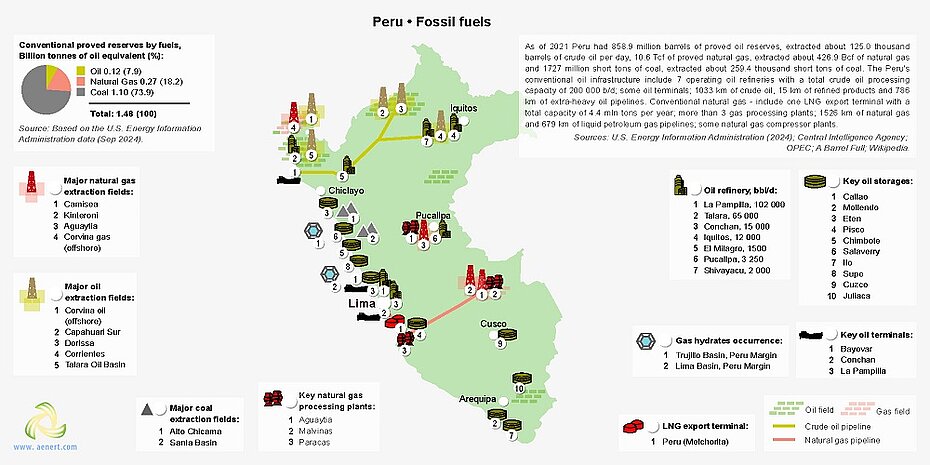
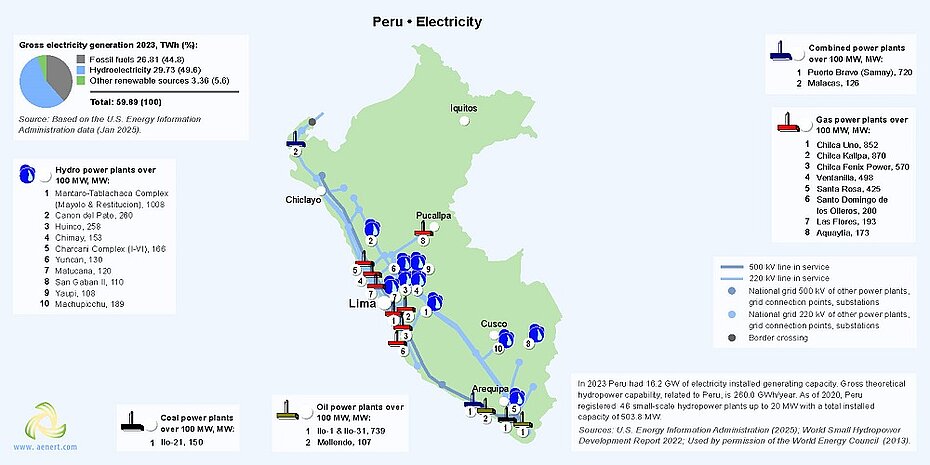
Peru’s electricity market is regulated by OSINERGMIN (Organismo Supervisor de la Inversión en Energía y Minería) and operated by COES (Comité de Operación Económica del Sistema) on the SEIN (Sistema Eléctrico Interconectado Nacional). MINEM (Ministerio de Energía y Minas) sets energy and mining policy. Peru’s grid is hydro-dominated (approximately 60% of installed capacity), with gas-fired generation from Camisea LNG providing flexible mid-merit dispatch.
The RER (Recursos Energéticos Renovables) auction programme, administered by OSINERGMIN under Decreto Legislativo 1002, has contracted utility-scale solar, wind, run-of-river hydro, and biomass projects through multiple bid rounds since 2009. RER projects sell under 20-year PPAs to COES with regulated tariffs. Peru’s off-grid challenge is acute: the Amazon region (Loreto, Ucayali, Madre de Dios) and high Andean rural communities outside the SEIN coverage area depend on diesel generation, and the cost of diesel delivery by river barge to Loreto can exceed six times the Lima price.
High-altitude mining hybrid power — HOMER Pro
Peru’s major mining operations — Cerro de Pasco (zinc, silver), Las Bambas (copper, MMG), Antapaccay (copper, Glencore), Toquepala and Cuajone (copper, SPCC), and Yanacocha (gold, Newmont/Buenaventura) — operate at altitudes of 3,700–4,700 metres above sea level. At these altitudes, diesel engines derate by 20–35% due to reduced air density, increasing fuel consumption per kWh generated. Combined with diesel delivery costs over Andean roads, effective electricity costs at mine sites can reach $0.35–0.60/kWh.
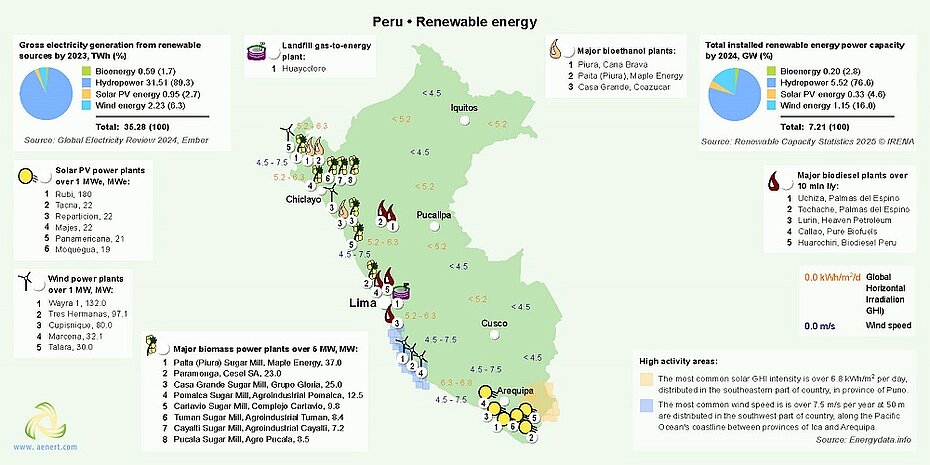
HOMER Pro models Peruvian mine-site microgrids with full altitude derating applied to diesel generator performance, solar generation profiles using high-altitude irradiance data (GHI at 4,000m in southern Peru exceeds 6.5 kWh/m²/day), wind generation for exposed Andean ridgeline sites, and BESS sizing for frequency support and diesel displacement. Mining decarbonisation commitments from Glencore, Newmont, and BHP are driving accelerating adoption of solar-BESS-diesel hybrid configurations that HOMER Pro quantifies for board-level investment decisions.
RER auctions and utility-scale renewables — HOMER Front
Peru’s RER auction rounds (1 through 4, 2009–2016) contracted solar projects in the southern Atacama-facing zones of Moquegua, Tacna, and Arequipa — where GHI matches northern Chile’s exceptional solar resource. Wind projects in Marcona (Ica) and Tres Hermanas (Ica) represent Peru’s Pacific coast wind belt. OSINERGMIN’s RER Round 5 and planned subsequent rounds are expected to introduce BESS co-location requirements as COES manages increasing variable renewable penetration on the southern and northern SEIN branches.
HOMER Front models Peruvian utility-scale renewable project economics: solar generation at southern Peru’s Atacama-equivalent irradiance, wind profiles for the Marcona coastal corridor, COES spot price dispatch against RER PPA obligations, and BESS co-location sizing for curtailment risk management. The combination of excellent southern resources and COES’s non-firm renewable dispatch rules creates specific optimisation challenges that HOMER Front addresses through probabilistic curtailment modelling.
Amazon off-grid and rural electrification — HOMER Pro
Peru’s Amazon region — Loreto, Ucayali, Madre de Dios, and parts of Amazonas and San Martín — contains hundreds of communities beyond the SEIN. Many are served by diesel generators operated by Electro Oriente, Electro Ucayali, or community cooperatives, with fuel delivered by river boat. Electricity costs in remote Loreto communities can exceed $0.80/kWh after accounting for logistics and maintenance. MINEM’s rural electrification programme, supported by FONER II (Fondo Nacional de Electrificación Rural) funding, targets solar-battery hybrid systems for these isolated communities.
HOMER Pro models Peruvian Amazon off-grid systems: solar generation at equatorial forest conditions (GHI 4.5–5.5 kWh/m²/day with variable cloud cover), diesel hybrid backup, and the economics of solar-battery versus diesel-only systems at Amazon logistics cost levels. Productive use loads — water pumping, community refrigeration for fish and produce, health centre power for vaccine cold chain — are native to HOMER’s load characterisation framework. FONER II-funded projects require HOMER Pro feasibility models for grant applications.
Peruvian market context
OSINERGMIN (Organismo Supervisor de la Inversión en Energía y Minería)
Regulates electricity and mining energy. Administers RER auctions, sets distribution tariffs (NTCSE), governs self-generation rules for mining operations, and approves grid connection for renewable energy projects.
COES (Comité de Operación Económica del Sistema)
System operator for the SEIN (Sistema Eléctrico Interconectado Nacional). Dispatches generation on a merit-order basis, sets the spot price (precio en barra), and manages the RER dispatch rules for non-firm renewable generation.
RER (Recursos Energéticos Renovables)
Peru’s renewable energy auction programme under Decreto Legislativo 1002. Contracts solar, wind, small hydro, and biomass projects on 20-year PPAs with regulated tariffs. Multiple rounds completed; further rounds under preparation.
FONER II (Fondo Nacional de Electrificación Rural)
National rural electrification fund administered by MINEM. Co-finances off-grid solar-battery systems for isolated communities beyond the SEIN. Requires HOMER Pro feasibility models for grant applications and implementation documentation.
Foundational HOMER references
View full bibliography →HOMER is used for energy projects in Peru and over 190 countries worldwide. Its modelling methodology — developed at the U.S. National Renewable Energy Laboratory (NREL) — is documented in these foundational references. Browse the full bibliography for 1,000+ applied studies.
-
Computer Modeling of Renewable Power Systems
Lilienthal, P.D., Lambert, T.W. & Gilman, P. (2004). Encyclopedia of Energy, NREL Report CH-710-36771.
-
Using HOMER Software, NREL's Micropower Optimization Model, to Explore the Role of Gen-sets in Small Solar Power Systems (Case study: Sri Lanka)
Givler, T. & Lilienthal, P. (2005). NREL/TP-710-36774.
-
Review of software tools for hybrid renewable energy systems
Sinha, S. & Chandel, S.S. (2014). Renewable and Sustainable Energy Reviews, vol. 32.
Ready to model your Peru project?
Whether you’re sizing a solar-BESS-diesel hybrid for a high-altitude mine, modelling a RER auction project in the southern solar belt, or designing an off-grid system for an Amazon community, HOMER gives you the analysis your engineers and investors require.